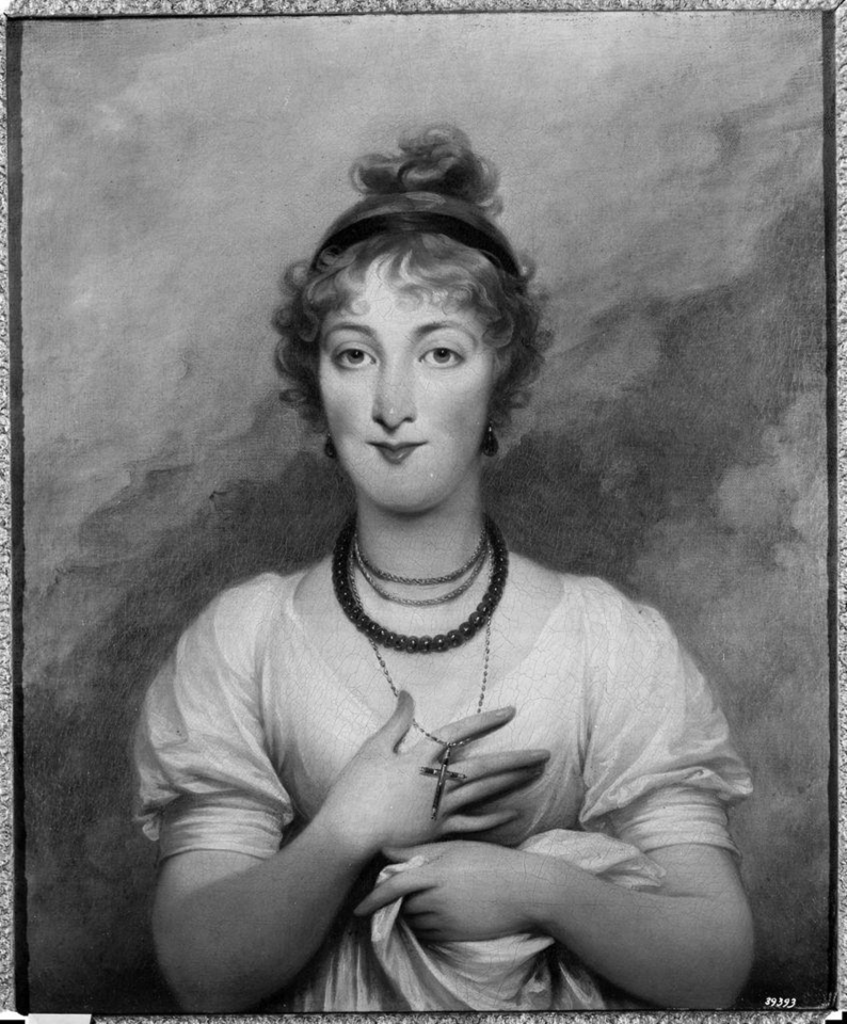
Harvey, shown in a billowy white dress, exudes innocence in this portrait. This is exactly the message that Trumbull hoped to send to his family. Her strawberry blonde hair is tied up in a bun high on her head. She has curls that have come loose that surround her face. Harvey wears a headband or ribbon that helps to frame the curls around her face. She also has small dangling earrings. Her deeply set eyes are framed by tall arching eyebrows. Harvey has a prominent nose that sits above her small, pursed lips. Her skin is milky white and leads to a slender neck where she wears several necklaces. Harvey wears two choker necklaces, one eye-catching red beaded necklace, and of particular note, a long cross necklace. This cross is no doubt meant as a symbol of purity and faithfulness as an introduction to his family back home.
Harvey’s neckline is a wide V-neck, but her dress sits high enough that no cleavage shows. Her dress has thin gauzy puffed sleeves that are gathered above the elbow. The cuff of the sleeves is tight on her arms and gives the appearance that even if she is slender, she is curvy. Her right hand is placed over her heart and clutches the cross necklace. Her fingers are thin and delicate, and she wears no rings. Harvey’s other hand clutches part of her dress up to her abdomen in what appears to be a nervous gesture. Behind her is a moody, cloudy background to give contrast to the paleness of her dress and skin.
The first portrait that Trumbull painted of his wife came right after their wedding and meant an introduction of her to his family in America. The reason why she needed such an introduction is that Harvey and Trumbull had married in haste. Some rumors have circulated as to the reason for the haste, and indeed their meeting must have been intense and passionate. When asked about it later, all Trumbull remarked was that he had married to “atone for a sin.” Within a year of meeting, Trumbull and Harvey married on October 1, 1800. Trumbull had grown up in Colonial America and was a Calvinist by birth. His strict, toned-down faith took a subordinate position at their high church Anglican wedding in Hendon, then a suburb of London, even if attendance was sparse (Fig. 18). [1] Trumbull only had two friends attend their ceremony and Harvey only had one. It is recorded at their wedding that Rufus King, one of the two of Trumbull’s friends in attendance. He acted in the father’s role giving the bride away, and asked Trumbull who was this woman that he was marrying so hastily. Trumbull replied curtly, “She is Mrs. Trumbull, sir.” [2]
There are no other documents to known of Harvey until the year 1799. This is the year that Trumbull filled out a lease for Harvey to rent a room in a house in Marylebone, which is a London suburb. In this lease, Harvey is listed as “Sarah Hope Harvey.” [3] There is no explanation as to why her name had changed from Hope to Harvey, although people speculate on an unknown marriage. In fact, when Trumbull filled out the marriage registrar at the church, he listed Harvey’s maiden name as Hope, lending credence that she had been married before. [4]
Early in their marriage, Trumbull’s nephew came to visit the couple in England. Upon spending time with Trumbull and his wife, he wrote home to the Trumbull family in America that she was a “fine woman.” [5] However, this fine woman was virtually without a history or connections living in a culture full of society people that valued those things very much. Further in his letter, the nephew writes that she “has neither Father, Mother, Sister, Brother, Uncle, Aunt, and [I] may almost say Friend.” [6]
[1] Brookhiser, Richard. Glorious Lessons: John Trumbull, Painter of the American Revolution.
[2] Brookhiser, Richard. Glorious Lessons: John Trumbull, Painter of the American Revolution.
[3] Brookhiser, Richard. Glorious Lessons: John Trumbull, Painter of the American Revolution.
[4] Sizer, Theodore. “The Autobiography of Colonel John Trumbull, Patriot-Artist.”
[5] Brookhiser, Richard. Glorious Lessons: John Trumbull, Painter of the American Revolution.
[6] Brookhiser, Richard. Glorious Lessons: John Trumbull, Painter of the American Revolution.