This painting is part of a collection of paintings that Trumbull painted after the couple had left New York and moved back to London. The economy in New York had become increasingly financially strained and so commissions for portraits had become increasingly scarce. [1] Trumbull and Harvey thought that moving back to England might be the answer to their economic hardships. Once there, however, it became clear that money was as scarce in England as in America because of England’s political troubles with France. [2] These political differences with France affected their small family in two ways because first money was limited, and second people were suspicious of Trumbull because he was an American. In this period of adversity, Trumbull turned to painting religious and historical scenes in which Harvey would figure prominently. [3]
One example of this type of work is the painting titled “Maternal Affection.” This painting is meant to call to mind similar depictions of the Virgin Mary nursing the infant Jesus. The imagery is even inclusive of an ornate perfume bottle which is likely meant to symbolize the oil spikenard. Spikenard was an anointing perfumed oil used during Biblical times and is available today. [4] It is recorded that Mary poured this oil over the head of Christ after the crucifixion, so the oil is often included in depictions of Mary and Christ, as an infant and at the crucifixion. So then, the perfume bottle would have given another clue that Trumbull was painting Mary and baby Jesus.
This portrait is important because it is a secularized depiction of the Virgin Mary. [5] There is enough symbolism to understand the subject, but at the same time, this is an early nineteenth-century portrait. Harvey’s dress is not from biblical times, nor is her hairstyle. In this way, Trumbull exhibits both religious faith and Enlightenment ideals in the same portrait. [6]
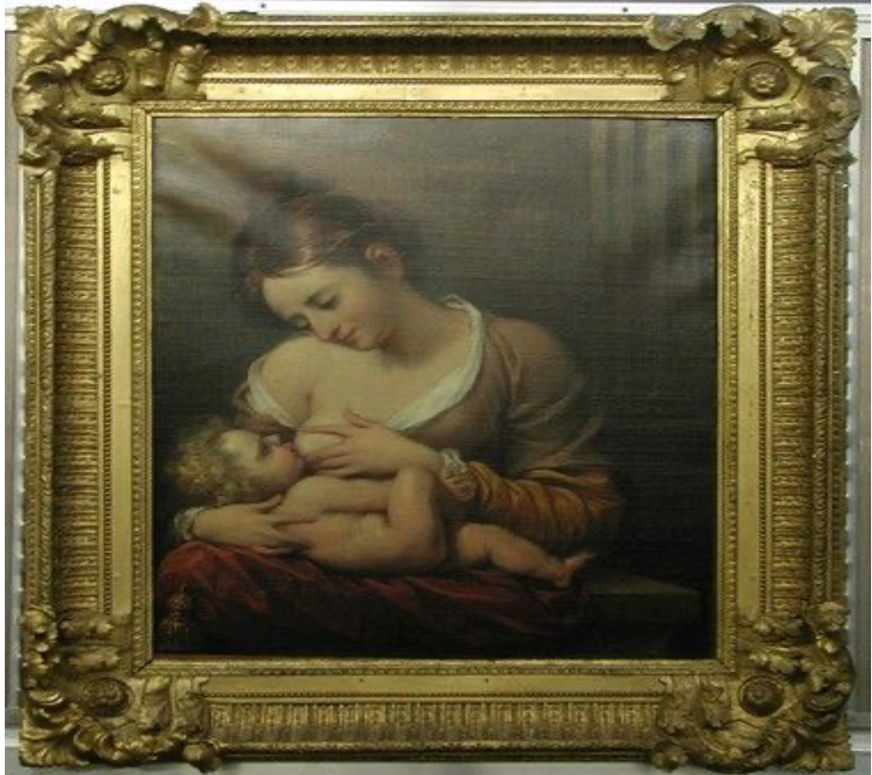
In the painting, Harvey is painted from the waist up, while she nurses an infant on her lap. Her hair is pulled back in a bun loosely with no other adornment in her hair. Her ear and neck are bare of jewelry. Instead of looking out at the viewer, Harvey gazes down softly at the baby on her lap. She has a small smile on her lips. Harvey’s dress is a bronze color and is open to show one breast and shoulder. She has an underlayer of white gauzy material that is shown above the bronze bodice of her gown. She has a long rust-colored sleeve that appears to be separate from the bodice that is trimmed in lace. The baby grips her left arm at the wrist as she holds her breast for the infant. Harvey’s right hand cradles the infant’s head from below. The baby is nude and chubby. Its right leg rests over its body, allowing the viewer to enjoy the baby’s round body. Harvey’s skirt is a deep red color. She sits with her leg resting on something like a stool to bring her knee up close to help the baby get a better grip on the breast.
Harvey sits on a classically styled marble bench with a marble column behind her. The rest of the background is a range of muted colors. In front of Harvey’s raised knee is a small bottle of something, possibly perfume or spices. This painting is even more poignant because the Trumbulls were never to have children of their own. Considering this, especially because it was painted in the beginning years of their marriage, there seems to be a possibility that there would be children in their future and that he thought Harvey would make an affectionate mother.
Trumbull would paint commissioned portraits, but this was also when, in the absence of portrait work, he would work tirelessly on religious and historical subjects. Harvey would prove to be a handy muse for this, as she shows up in many of these paintings Trumbull writes that at this time he felt very estranged from his family as they were no longer writing. In his letter dated 1812, Trumbull writes, “The silence of every branch of my family for nearly four years (except for one short letter from my brother) leaves me to suppose that I am quite excommunicated by them.” [7] The couple was not only isolated from family but they were also isolated from friends and society, as well. Tensions were high in England during the War of 1812. Trumbull, a Revolutionary War veteran, ex-American diplomat, and imprisoned spy was looked at with suspicion. As the War of 1812 continued, Trumbull was advised to leave London for Bath, and to report all his comings and goings to the government. [8]
The political and financial pressures were weighing heavily on Trumbull and allowed for one of the only times that there is a record of Trumbull saying anything remotely critical of his wife. The letter is to Rufus King, Trumbull’s longtime friend and associate. He is complaining of Napoleon’s confiscation of American property and is generally feeling discontented. He closes his letter with, “I am disgusted, my friend, sick of my country, Sick of my Family, sick of Human Nature, My poor, banished, persecuted, insulted ill-tempered Wife (curse the Scoundrel) joins in wishing health and happiness to you and yours.” [9] Feeling the pressure, the Trumbull family departed once more for America. This time they would stay.
[1] Brookhiser, Richard. Glorious Lessons: John Trumbull, Painter of the American Revolution.
[2] Brookhiser, Richard. Glorious Lessons: John Trumbull, Painter of the American Revolution.
[3] Brookhiser, Richard. Glorious Lessons: John Trumbull, Painter of the American Revolution.
[4] Brooke, Stopford Augustus. The Spikenard and Other Sermons. Lindsey Press, 1919.
[5] Cooper, Helen A., editor. John Trumbull: The Hand and Spirit of a Painter.
[6] Cooper, Helen A., editor. John Trumbull: The Hand and Spirit of a Painter.
[7] Sizer, Theodore. “The Autobiography of Colonel John Trumbull, Patriot-Artist.”
[8]Sizer, Theodore. “The Autobiography of Colonel John Trumbull, Patriot-Artist.”
[9] Sizer, Theodore. “The Autobiography of Colonel John Trumbull, Patriot-Artist.”