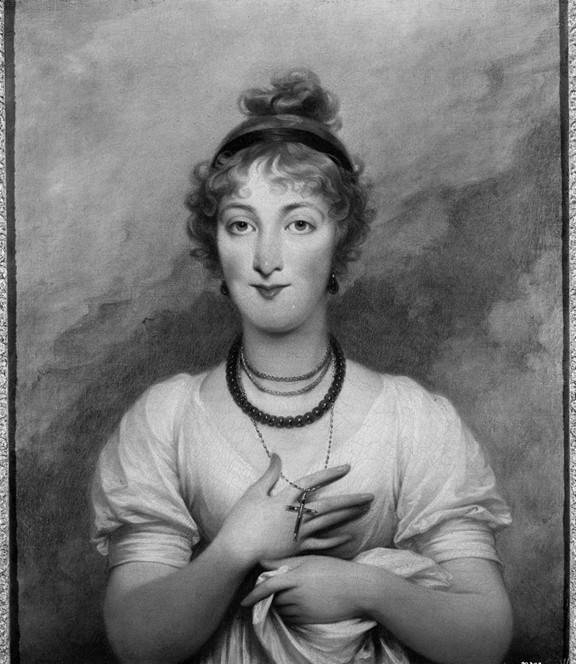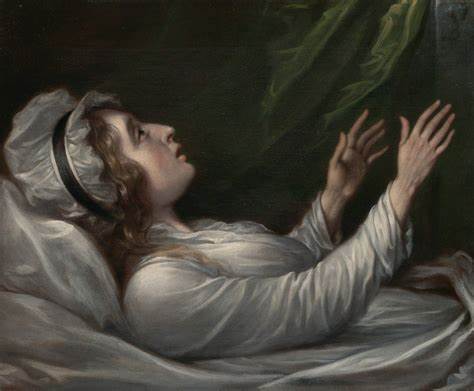
This painting is unlike the other portraits that Trumbull painted of his wife. This painting feels more intimate, perhaps because it is not posed but it is a moment. Harvey does not look at the viewer but looks directly above in a plaintive way. Is she looking toward heaven or a loved one? Is she praying for her pain to end? We do not know. She has aged since the last portrait Trumbull painted of her. Now her hair streams over her shoulders and her face looks tired. Her eyes are shadowed, and her face is flushed. Her mouth is slightly open as if to speak or in surprise. Harvey wears on her head a kerchief that is laced with a black ribbon, an ominous choice on the part of Trumbull. Behind the bed that Harvey lies on is a rich green silk-type curtain. It is gathered in folds to make her strawberry-blonde hair more noticeable. She wears a white gauzy nightdress that has an open neck and long loose sleeves. Both of her hands are raised in the air towards some unseen thing. Harvey’s arms are pale and most strikingly her hands, which always feature prominently in the portraits of her, are now thin and gaunt. Her hands seem to be the part of her that has aged the most, since her hair has not yet grayed. Her bed is well-appointed with its white linens and the blanket and sheet are pushed back to her waist as if she was restless in bed. This painting does not convey a peaceful death scene. Instead, it gives the impression of someone in pain and turmoil, uncomfortable and fighting until the last second, when she can fight no more. To the side of Harvey’s bed, away from the viewer is what appears to be a chair and possibly a nightstand. To the right of the chair is the beginning pattern of what could be bedroom wallpaper. These details give the already sad scene a personal touch as if we were also standing in her bedroom watching the scene unfold.
This was a deeply private portrait for Trumbull. Trumbull valued this painting greatly and he hung it over his bed for the remaining nineteen years of his life. He had the painting veiled with a green silk curtain for privacy. There are accounts of its veiling as early as 1879. Harry Willard French wrote that Trumbull “kept her portrait closely veiled at the head of his bed.” Anne Hollingsworth Wharton echoed this sentiment in 1897. Edna Leighton Tyler mistakenly thought that this was the sole painting that Trumbull painted of his wife, but in 1927 she described it as thus, “as he sat, day after day, beside his dying wife, Trumbull so charged his memory with her features and expression, that returning to his studio for brief intervals, he was able to immortalize on canvas the beauty of the closing hours of her life.”
Boettcher, Graham C. “The Artist’s Queen: John Trumbull’s” Sarah Trumbull on Her Deathbed”.” Yale University Art Gallery Bulletin (2015): 35-43. Pg. 42.