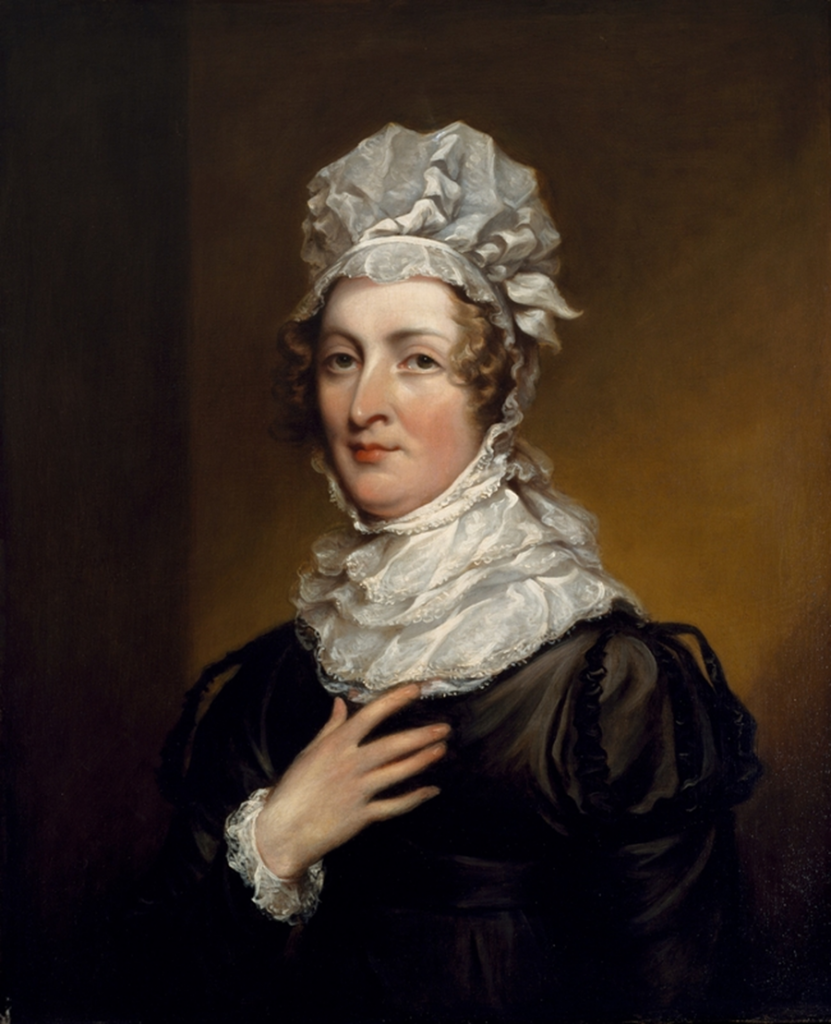
Now near her fifties and shortly before her death, Harvey sits alone in the portrait. Only hints of color and light surround her, although there is an implied wall behind her. The background of the portrait is dark with warm undertones that match her loosely curled hair. Much of her hair is covered under a lace kerchief. She has a fuller-shaped face with a small double chin. Her white collar comes up her neck. It has a satin finish and is edged with lace, showing attention to detail that Trumbull is known for. Her face and hand are the only visible skin in the likeness. The cuff of her dress is edged in a row of gentle elaborate lace. There is a simple air of dignity in her pose. She stares straight at the viewer gently but confidently in her space. Gone is the girl who had grappled with her dress in the introductory painting or the girl who had shyly turned away from the viewer. Now, Harvey holds the viewer with a subtle gaze.
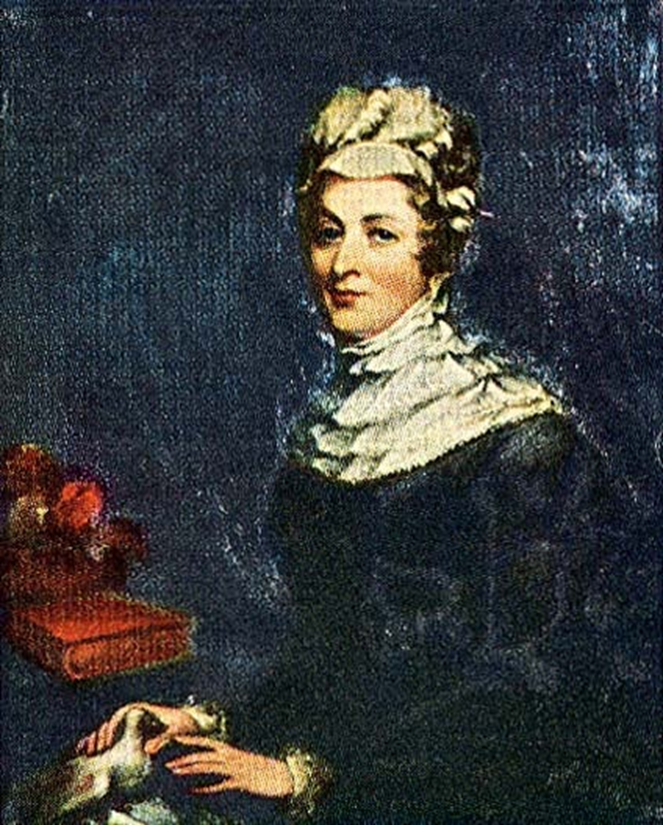
There is a similar portrait to this one that bears more details. The more famous painting showcases not only Harvey, but the second one gives clues as to what Trumbull might have been thinking at the time that the portrait was done. The background is blue in this painting instead of the usual color choice of a red based background that sets off her hair. She is sitting in the same dress and the same kerchief, but this portrait has a wider angle. Now we see that Harvey sits beside a bowl filled with apples. An apple can be a problematic symbol in art because there are a couple of different ways that it can be interpreted. From a biblical perspective, which Trumbull with his Calvinist ideals would have been likely to possess, an apple can represent sin, as in the Adam and Eve story. Apples do not always have to represent sin, however. The reason that Eve was tempted to eat the apple, in the beginning, was that the fruit symbolized knowledge and wisdom. From the rest of this portrait, her dignified dress and decorum, it is not a stretch to believe that Trumbull likely meant the apples to represent wisdom, as knowledge comes with age. This is especially true since the apples sit next to a book on the table beside her, which could also represent knowledge. Most tellingly, in her hands is a small white dove. One hand cradles the dove on her lap while the other hand tentatively reaches out to stroke it. Harvey has a small smile on her lips. She gazes out of the portrait with a playful look in her eyes. The dove, a longtime symbol of peace and love would denote a peaceful and mature relationship between Trumbull and his wife.
There is a sketch that goes along with these two paintings. It reads more humorously than the first two paintings. Instead of delicate beauty and refined taste, Trumbull has depicted Harvey as frumpy, and dowdy. Harvey’s mouth is pinched in a way that looks as if she might be sour. Her kerchief does not sit proudly on her head but droops and her hair in the back has come loose. She is round in this sketch instead of delicately well-fed. The ruffles of her lace collar align with her cheeks and double chin giving the impression that her only shape is round, with no defined neck.

Sizer, Theodore. “A Portrait of the Mysterious Sarah Trumbull.”