Isaac Suttles was a potter born in 1840 in Ohio. His father, Benjamin Suttles, was also a potter of some repute in Ohio during this time. When Isaac Suttles moved to Texas in the 1870’s with his younger brother George, he became involved with a group of ex-slaves-freedmen who already had some experience working pottery within the Guadalupe Company. These men, including Hiram Wilson, who started the well known H. Wilson & Company pottery enterprise, joined forces and shared industry ideas with one another, affecting the pottery styles of both. It is my belief that since there is no definitive dating to an exact year for any of the pottery from the Guadalupe Company, H. Wilson & Company or Isaac Suttles, that Isaac and his brother George influenced the making of pottery and changed the direction of the Wilson pottery and vice versa. Isaac Suttles’ interventions in the H. Wilson & Company pottery can be seen in the use of salt glazes as opposed to the alkaline glazes the men had used in the past. This is likely because of the use of salt glazes that Benjamin Suttles is known to have used in Ohio. In addition, it is probably Suttles’ interventions that gave H. Wilson & Company the idea to begin branding their pottery with their own emblem. This is because Benjamin Suttles, Isaac’s father, had done the same to his own pots back in Ohio as Isaac was growing up. Wilson’s intervention to Suttles’ pottery work can be seen in the use of the horseshoe handles that make carrying the jugs easier and less likely to break and the wider neck of the pottery making them easier to carry and easier to seal. The temporary joining of forces between the men of H. Wilson & Company and Isaac Suttles, along with his brother George, improved the look, durability and profitability of all of the men’s pottery work. This is a great example of two (or more) minds are much better than one.
Isaac Suttles History
Isaac Suttles, born in 1840 in Newton, Ohio. He was the second oldest child of Benjamin Suttles and his wife Elizabeth, and was their oldest son. When Isaac was only twenty-three years old, the Civil War broke out and he served the entirety of the war as an enlisted Private on the Union side from 1861-1865 when he was discharged. One source lists that he was a prisoner of war in the much feared detention area in Andersonville, Georgia. Included is a military record for the state of Ohio in 1863 in the service of the Union Army listing his occupation as “Potter.”

Just after the war, in 1866, Isaac married Mary Ann McBride. They were married on April 22, 1866. The marriage license does not list the location of the ceremony, only that it occurred in Muskingum, Ohio.

It is not known the history of his marriage to Mary Ann except that in 1870, when Isaac moved to Texas, it appears that she did not come with him. Furthermore, in an 1880 Census taken in Wilson, Texas, Isaac’s marital status is left blank, and he is listed as being a boarder in the house of a John Franklin. Since Wilson, Texas is a full five hour drive from La Vernia, Texas, it can then be surmised that Isaac Suttles did his pottery work with Hiram Wilson and others between the years of 1870 and 1880. Included is a copy of the 1880 census in Texas to show Isaac Suttle’s location and circumstance.

Benjamin Suttles History
Benjamin Suttles, born in 1818 and Isaac’s father, worked as a potter in the mid1800’s. The elder Suttles, was an accomplished potter in Ohio. Benjamin worked as a potter in Newton Township, Ohio when the state was having a sort of pottery renaissance in the nearby town of East Liverpool. Benjamin Suttles enjoyed his own successes. He made salt glazed pottery, much like his own son would produce later. Included is a picture of an 1850 census showing that Benjamin Suttles lists his occupation as “Potter” and all of the occupants of the home during that time.
The pottery that Benjamin Suttles created in Ohio, and later his sons Issac and George Washington Suttles in Ohio and Texas, had a salt glaze. The process of salt glazing is much less labor intensive than alkaline glazing which uses ash based slip to coat the pottery. With alkaline glaze you must coat each piece individually but salt glazing is different because a potter can throw salt into a hot kiln and the salt vapor will glaze each pot.
Benjamin made the jugs with what are called “cup” handles. These handles, although traditional, often break, but were the norm for 19th century potters. Handles such as these can be seen in pottery dating back to ancient Greece, but necessity being the mother of invention, Isaac would surpass his father and would later employ horseshoe shaped handles to prevent breakage. The horseshoe shaped handles adhere to a greater surface area on the pot and also jut out a much smaller distance from the surface of the pot. Both of these advantages give the horseshoe shaped handles a distinct advantage over the traditional cup shaped handles.
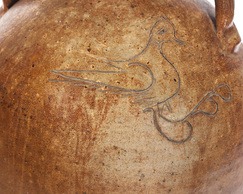
Benjamin added another recognizable element to his pottery that is likely the catalyst, through Isaac Suttle’s intervention, for the branding on H. Wilson Pottery’s wares. On Benjamin Suttles’ pottery, there is a recognizable logo- a bird on a branch. This bird sits on a branch that has a flourish that resembles a capital “B.” There is also a faint signature of Benjamin Suttles, which introduces the idea of inscribing pottery as a way of advertising to his son, Isaac Suttles, and later the Wilson brothers in Texas. Included is an image of a pot by Benjamin Suttles that shows his branded image.
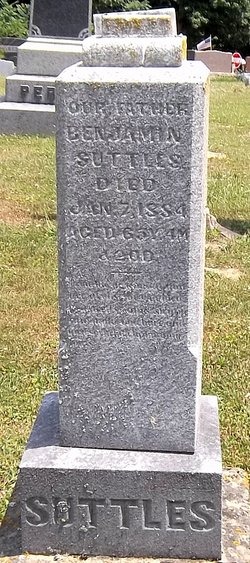
Benjamin Suttles died on Jan. 7, 1884 at sixty-five years old. He is buried in Wesley Union Cemetery in Muskingum, Ohio.
H. Wilson & Company Pottery History
In LaVernia, Texas, Hiram Wilson and his brother were also busy making pottery. First, as slaves laboring for the Guadalupe company, then after the Civil War as freeman for their own company. Much has been written about this group and in fact the Museum of Fine Arts Houston, MFAH, published a book detailing the history of this pottery establishment in 1984. The Guadalupe company (mostly) used an alkaline glaze for its pottery and so the Wilson brothers continued this tradition in their own business when they began. However, using a salt glaze instead improved their profitability and productivity because of the ease of glazing many pots at once. They did make an innovation of their own, however, that improved upon the designs that they had used in making pottery for the Guadalupe company. This innovation is known as the horseshoe handle. This improvement sits closer to the vessel and is connected to the pot over a larger area. This improvement results in the handles breaking less often evidenced by the pottery from this time period with horseshoe handles still in place, while cup shaped handles are often broken.
Isaac Suttles’ Tragic Death
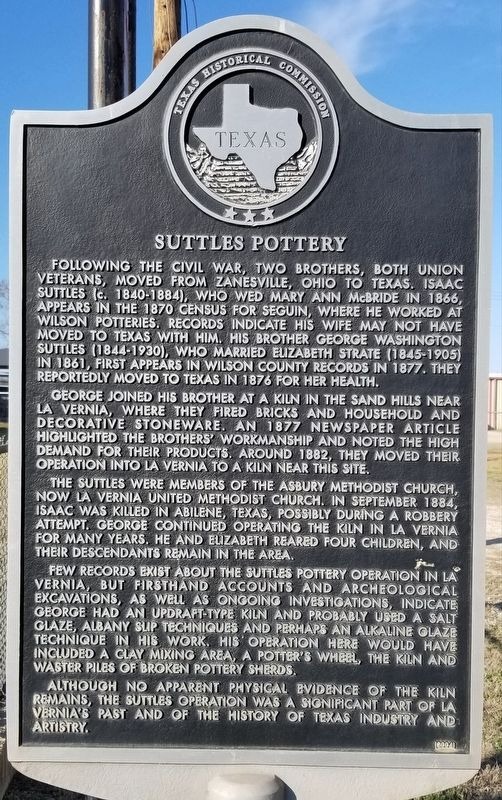
Isaac Suttles died unexpectedly in 1884. He was murdered either as part of a robbery or by using a robbery as a ruse for murder; it was never clear. He was shot in the head. No arrests were ever made in the case and one source claims that Isaac’s wife lacked the funds to retrieve his body. A personal anecdote reveals that he was a lifelong Methodist and, at the time of his death, had perfect Sunday School attendance. There is no record of where Isaac Suttles was buried. At the time of his death, he was living in Abilene and working as a peddler. It is uncertain why he was not still working as a potter full time, but instead as a salesman. It is possible that he traveled the area selling all sorts of goods, as well as any pots that he had made to sell. His brother George Suttles continued to make pottery in LaVernia, Texas after Isaac’s tragic death.

In honor of the Suttles brothers, a historical marker was erected in 2004 near LaVernia, Texas.
Pottery Examples
Let’s examine some pottery to see the evolution of styles between Benjamin Suttles, Isaac Suttles and the H. Wilson & Company pottery pieces.
Example of Benjamin Suttles Pottery. Third Quarter of the 19th Century.

Example from the Guadalupe Company. This jug is alkaline glazed and includes the cup shaped handle that increases the likelihood of breaking.

Example of H. Wilson & Company Pottery. No branding. C. 1860’s.
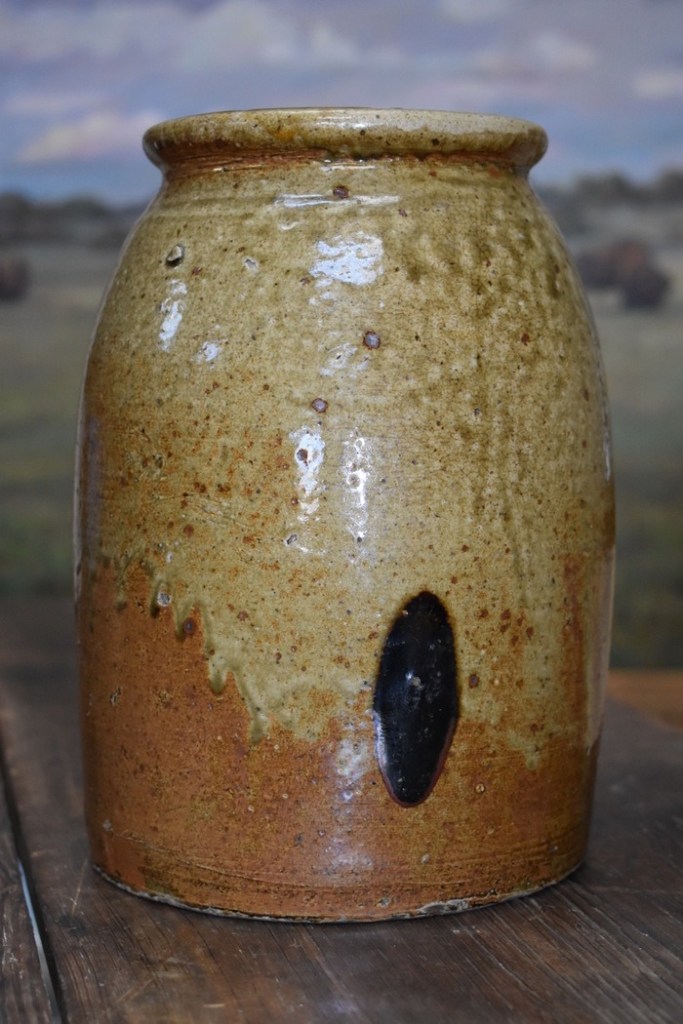
Example of Isaac Suttles Pottery with cup shaped handles and salt-glaze. 1869-1873

H. Wilson & Company Pottery example with horseshoe handles, salt glaze and branding on the side. 1869-1873.

Isaac Suttles with salt glaze, horseshoe handles and I. Suttles brand on side.

Resources
“I. Suttles Pottery – 5 Gallon Storage Jar. Signed | Vintage Texas Paintings.” Charles Morin’s Vintage Texas Gallery, www.vintagetexaspaintings.com/antiques/759-i-suttles-pottery-5-gallon-storage-jar-signed.
“Benjamin Suttles.” Geni_Family_Tree, 1818, www.geni.com/people/Benjamin-Suttles/6000000189766310888#/tab/timeline.
“Benjamin Suttles BlueBird Pottery.” Invaluable.com, http://www.invaluable.com/auction-lot/ohio-stoneware-jug-75-c-76242ca916. Accessed 1 Sept. 2024.
H. Wilson and Company Pottery. www.thestoryoftexas.com/discover/artifacts/wilson-pottery-spotlight-022715.
Marriage License
. www.ancestry.com/discoveryui-content/view/2752704:61378.
“Volunteers Try to Piece Together Potters’ Places in History.” Chron.com, www.chron.com/news/houston-texas/article/volunteers-try-to-piece-together-potters-places-2128509.php. Accessed 2 Sept. 2024.
“Isaac Suttles.” Geni_Family_Tree, 1 Jan. 1841, http://www.geni.com/people/Isaac-Suttles/6000000189766621833?through=6000000189766310888.
The Museum of Fine Arts, Houston. emuseum.mfah.org/objects/107131/threegallon-jug?ctx=fb8b3fea91fe8ac05ff7666ac8386b1f6675cf19&idx=10.
The Museum of Fine Arts, Houston.
emuseum.mfah.org/objects/107165/twogallon-jar?ctx=dd5463bced3795ab5d34b08c182462b590731726&idx=31.
1880 Census Information
1850 Census Information
Civil War Draft Information
—. www.ancestry.com/discoveryui-content/view/4258202:1666.
“Isaac Suttles- Horrible Murder.” Ancestry.com, www.ancestry.com/mediaui-viewer/collection/1030/tree/150701224/person/422391992328/media/67c3154f-45c8-4610-9954-cead28660c0d?queryId=d1cf19ab-e9b3-4afa-8145-a512c9eeb6a4&_phsrc=TbT277&_phstart=successSource. Accessed 2 Sept. 2024.
The Museum of Fine Arts Houston. emuseum.mfah.org/objects/117531/fivegallon-jug?ctx=f9d361881db53af3c0e21313ebc52ae79ee40b61&idx=4.
Morgan, Molly. “Archaeological Research at the Wilson-Durham-Chandler Site.” Index of Texas Archaeology: Open Access Gray Literature from the Lone Star State 2009.1 (2009): 14.