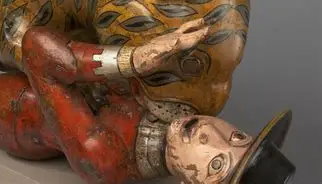
Tipu’s Tiger is on exhibition at the Victoria and Albert Museum in London, England. Basically, it is a carved piece of wood made to look like a British soldier being mauled by an Indian Tiger. The soldier is lying flat on his back, while the tiger is crouched on top of him, chewing his shoulder.…
Another student of Benjamin West, Charles Wilson Peale, studied with him a few years before John Trumbull came to study with West. Peale’s father died when he was still a child, so Peale had to drop out of school and apprentice to a saddle-maker. He was not especially suited to this profession and when he…
Gilbert Stuart, like Trumbull, studied under West. Several stories have circulated as to how Stuart became a pupil of West. One story has Stuart send a letter to West imploring, “Pity me Good Sir, I’ve just arrived at the age of 21 an age when most young men have done something worthy of notice &…
After Harvard and his service in the American Revolution, John Trumbull left America to study under Benjamin West. West was an American painter who had begun life as a portrait painter but had progressed in talent and respect enough to now be the official painter of George III. West was well known for his history…
As a youth, John Trumbull balked at going to Harvard. Trumbull records, “The tranquility of the arts seemed better suited to me than the more bustling scenes of life, and I ventured to remonstrate with my father, stating to him that the expense of a college education would be inconvenient to him, and after it…
From the mid to late 18th century, Sir Joshua Reynolds was the premier portrait artist in England. Reynolds, long-time President of the Royal Academy, consummate art educator, and author of “Discourses” would have been familiar to Trumbull from his time spent studying art under West in London. Reynolds had much to say about the theory and…
Before John Trumbull was born, John Wollaston was one of America’s earliest portrait painters. Beginning from around 1749, Wollaston was a prolific portrait painter. Some researchers say there are at least three hundred portraits suspected to be by Wollaston, while others say there are only two hundred portraits. Officially, there are about seventy-five portraits credited…
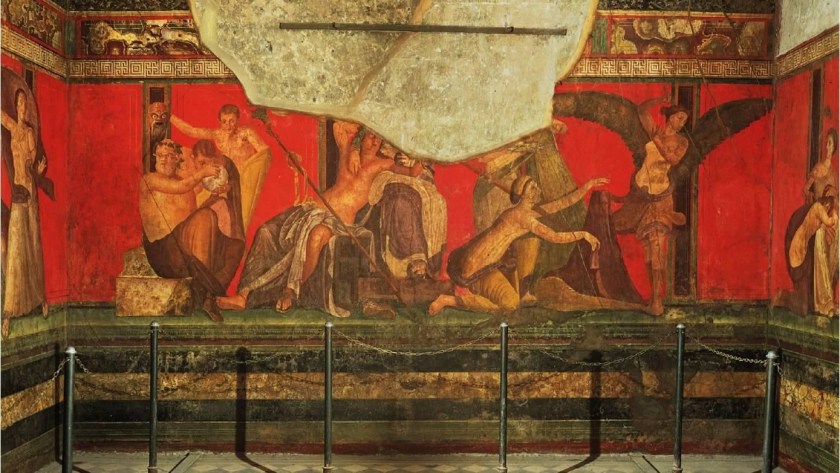
It is easy to forget that even though much of Roman art has lost its luster and color over the centuries, in the beginning, Romans loved vibrant painting. Romans would paint murals on walls for decoration and to show affiliation with politics, religion or wealth. These paintings could be found in public and private buildings…
There are many ways to study the Roman Empire and its culture. One of the best ways to learn more about this timeframe is to study Roman portraiture and with all of its nuances and symbols. This was the first time in history that portraits were being made with the spectator in mind. These likenesses…
Part I- Technical Analysis
Sarcophagus created for Roman Military Commander- Funerary Art.
Artist- Unknown Roman
Date 140 AD- 170 AD (MFAH, 2023)
Medium- Warm Cream Marble
Dimensions- 40 1/2 × 91 1/2 × 50 1/2 in., 5511.5lb. (102.9 × 232.4 × 128.3 cm, 2500kg)
Provenance- Private collection, Eastern Europe, 19th century; purchased by Pierre Sciclounoff,…
Although the exact date of creation for this sarcophagus is unknown, experts believe that it was made in the second century in Rome. This tomb falls under the category of “mythological sarcophagi” which means that the relief panels are taken from mythology instead of biographical information. This was a common theme among sarcophagi during the…
The statue of Marcus Aurelius on horseback is beautiful to behold. It is lucky to have such a piece of history, and it is only through luck that we are able to enjoy it. This is because the statue at some point had been erroneously labeled as Constantine, the first Christian Emperor of Rome, and…