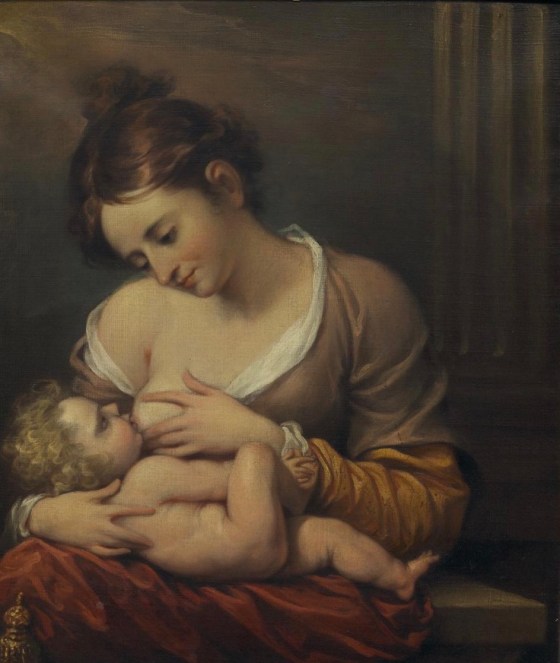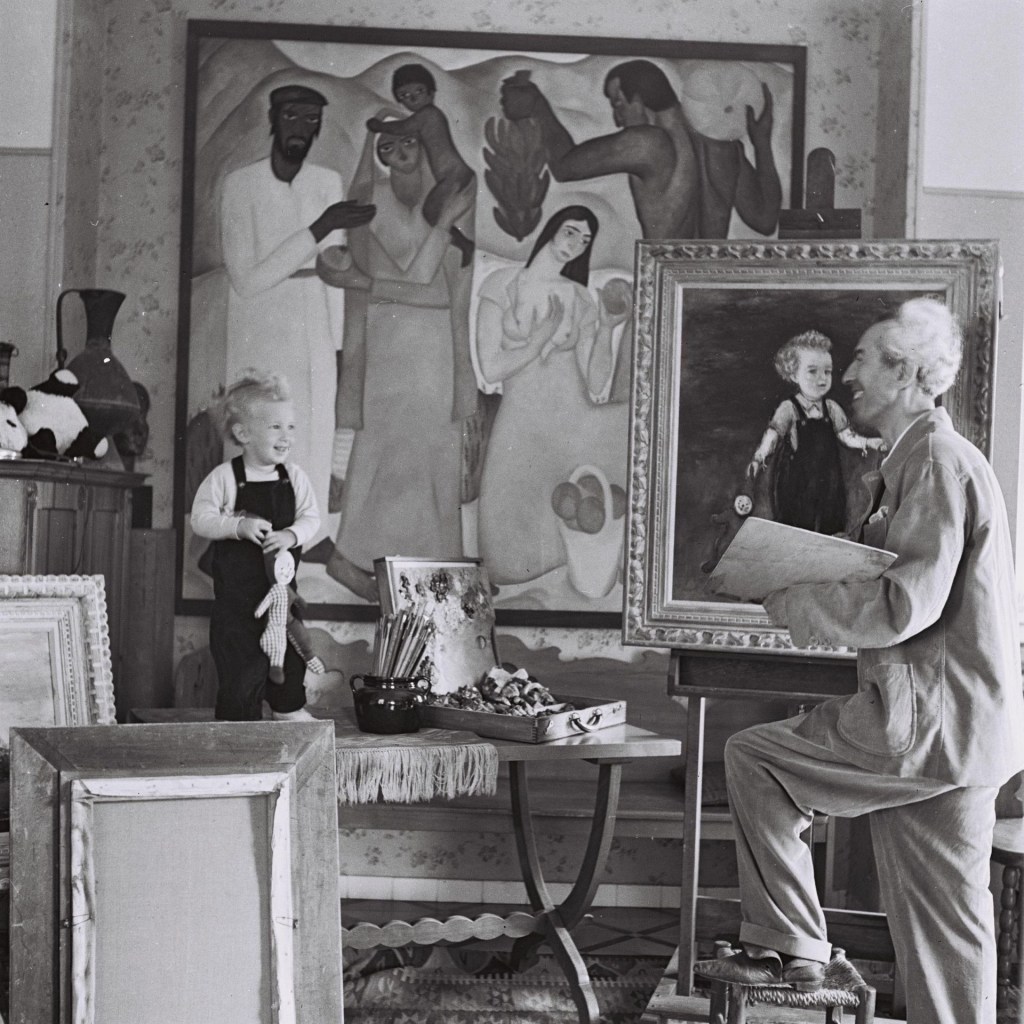
Reuven Rubin did not come from a rich family. He grew up in Romania, in what he called a little ghetto. Even at a young age, though, Rubin showed artistic talent. He recounts the story of when he was three and came home from his first day at heder. He held a piece of brick in his pocket that he had etched into a portrait of the Rabbi. He did such a fine job that his brother recognized the subject and Rubin explained, “I had actually drawn a likeness that could be recognized. My first day at heder, my first drawing, and my first artistic success!”. Rubin often felt misunderstood by his family who did not value his artistic personality. He was often bitter and would cry to find that his mother had used his sketches for some menial household task, such as wrapping cheese or mopping up milk. When Rueven was a little older he recounts a story of humiliation where his father was slapped in the face by a Gentile neighbor because he had asked to retrieve the children’s ball from his yard. Rubin says that he decided then that he wanted to go to Palestine, “In my humiliation I swore that I would not always live in such a country. Maybe it was at that moment that it became clear to me that one day I would go and live in a country where a Jew could lead a free, dignified life—Palestine.”
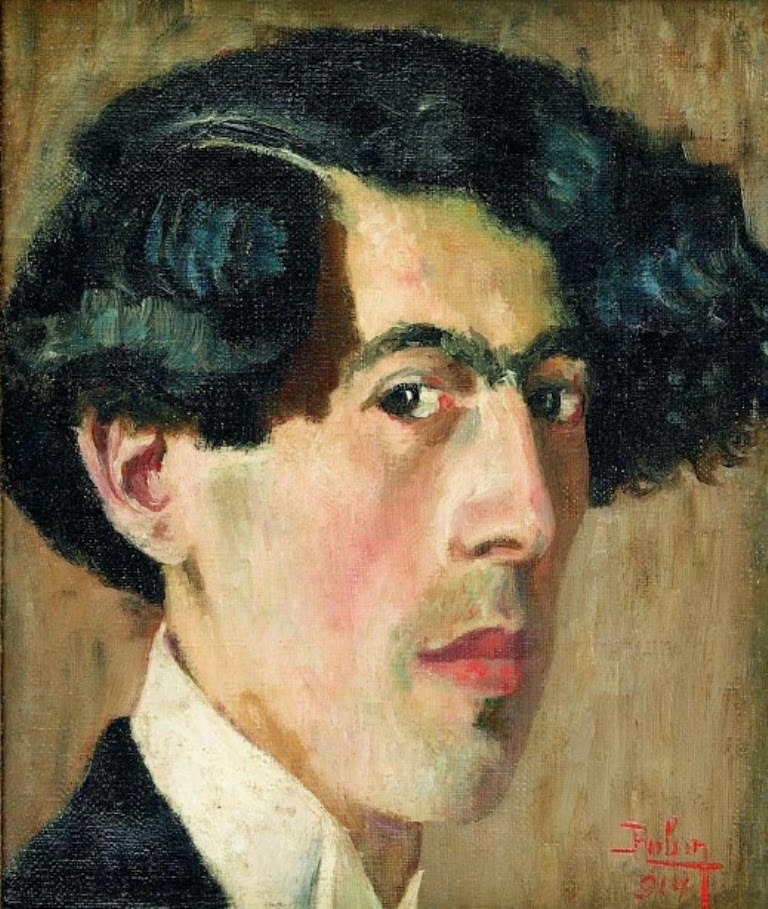
Reuvan Rubin. Self- Portrait 1914.
Although a renowned Israeli artist, Reuven Rubin was never a student at the Bezalel School. He actually had been an art student in Paris, France and came to Palestine in 1912. Rubin was a contemporary of the artists at Bezalel and worked in the same circles. His name was well known among patrons of Judaica art during the early part of the 20th century in Palestine, as well as the artists. So, although he did not attend or instruct at the Bezalel school, he was an influential member of the Jewish art community in that area at that time. Rubin’s style, as compared to the Art Nouveau style of Bezalel, focused more on everyday people and scenes that would have been familiar to the early 20th century Jewish community. Rubin, with Jewish pride and hope for the future, shared a common goal with the Bezalel school and helped to lay the foundation for Jewish artists to come.

Reuvan Rubin. Self- Portrait 1923.
This set below of 12 lithographs by Rubin showcases his talent and is printed on special paper. Each lithograph measures 23.23 inches high by 19.5 inches wide. They are printed on Arches paper which is a type of paper that is common among lithographs and watercolors because of its warm undertone and texture. This type of paper is named for the city in France where it is produced in a mill that dates back to 1492. Below is a picture of the Arches Paper Mill in Arches, France, from their website detailing their long history in paper.

These lithographs were printed by Fernand Mourlot, pictured below. Mourlot was well known for printmaking among artists. Mourlot, respected in the art world, worked with Picasso, Matisse and Chagall, as well as Rueven Rubin.

Rueven Rubin was proficient in many mediums of art, and he became well known for his lithography. Lithographs had become popular in the latter half of the nineteenth century and early twentieth century as a way to make many prints that were detailed in tone and minutia. Generally, a flat stone, like a limestone, was used in the creation of a lithograph, a flat metal plate can also be used. The image is created with a type of greasy crayon that adheres to the stone. The image is created in the reverse. Ink is then applied to the stone, but the ink cannot adhere to where the grease has been applied. In this way, a paper can then be pressed against the stone, and the image will be transferred to the paper. This can be done many times. Even though many prints can be made from a stone, each print is considered to be an original work of art because an artist is still doing the work of pressing the image into the print (Pennell, 3).
The subject matter of the lithograph set is the life of King David. King David is a central figure in the Jewish faith. There are many parts of David’s life that make him a hero in Judaism, for example the well-known story of David and Goliath. David, still a very young man, defeats Goliath. David is unprotected and basically unarmed, but he prevails. This story symbolizes G-d’s protection of the Jewish people then and now. Another important story from King David is his romance with Bathsheba. This story is very powerful to illustrate G-d’s mercy and forgiveness. If G-d can forgive David, for lust and murder, then we can also depend on G-d to love and protect us, as well. Both of these stories are depicted in the lithographic set, as well as other points in King David’s life, such as being anointed with oil by Samuel and David playing music for Saul. These prints are saturated with blues and golds and show a modern aesthetic for the timeframe. Each of these prints are associated with a corresponding verse. The verse translation is a modern one and picked by the artist, Rueven Rubin, himself, to describe the prints.
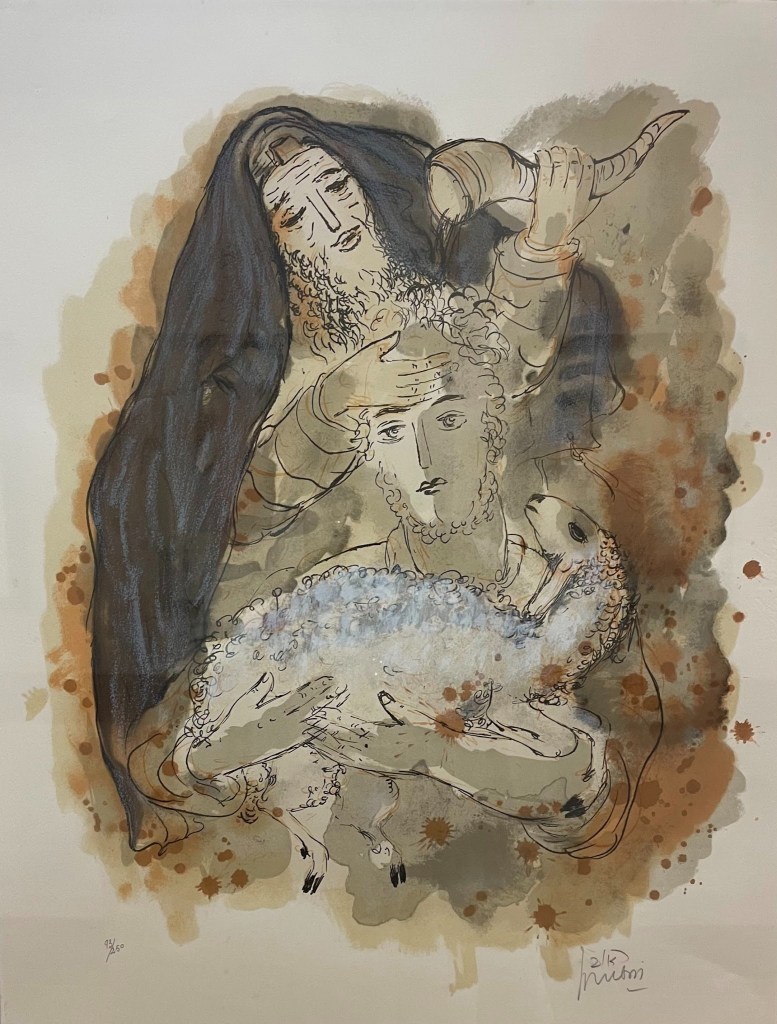
- Samuel took the horn of oil and anointed him in the midst of his brethren.
Samuel 16:13.
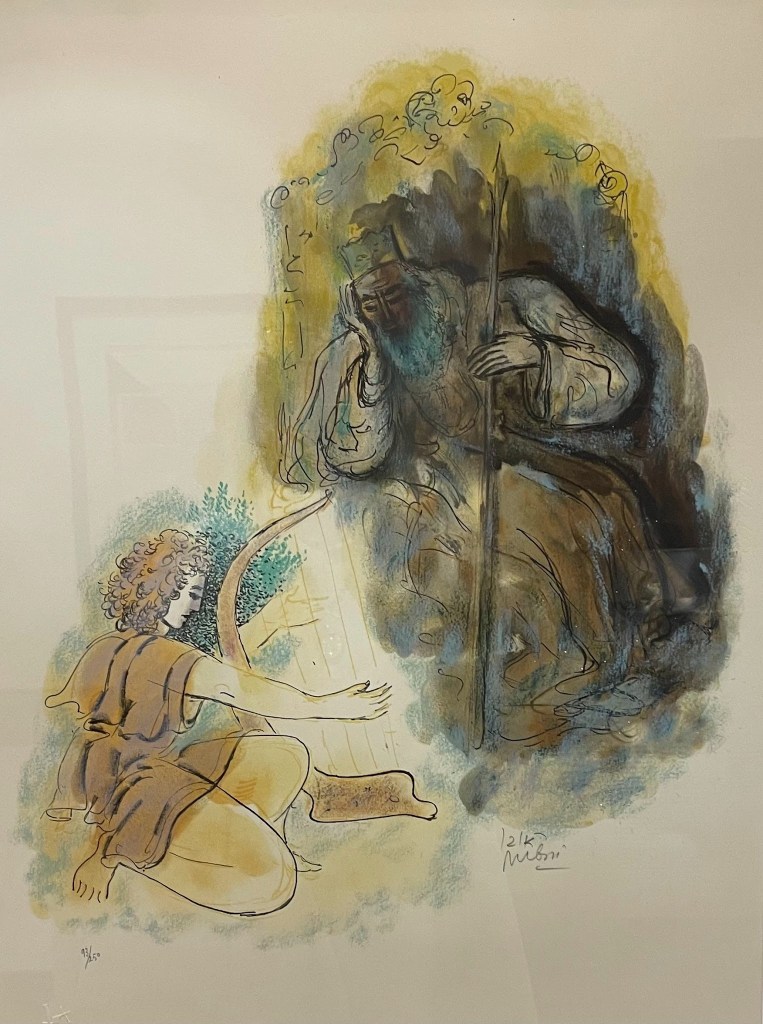
- David would take the harp and play it with his hand; Saul would be refreshed and feel better, and the evil spirit would depart from him.
I Samuel 16:23
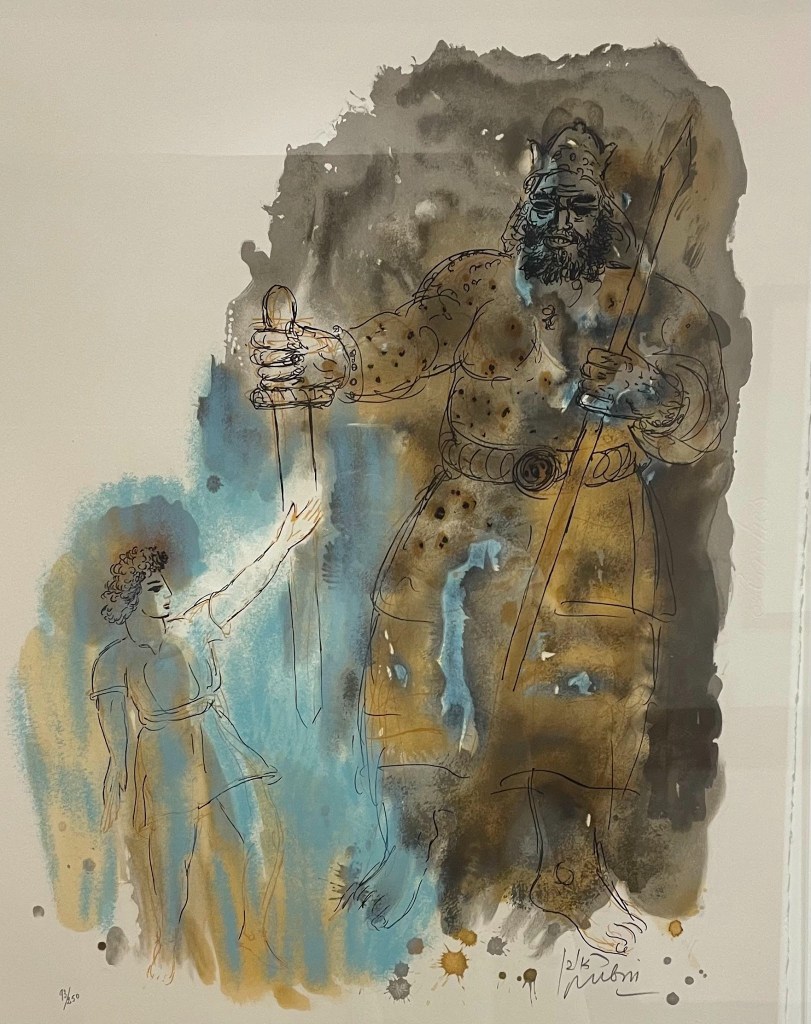
- Then said David to the Philistine, “You come to me with a sword and with a … but I come to you in the name of the Lord.
I Samuel 17:45

- Jonathan and David made a covenant, because he loved him as his own soul.
I Samuel 18:3
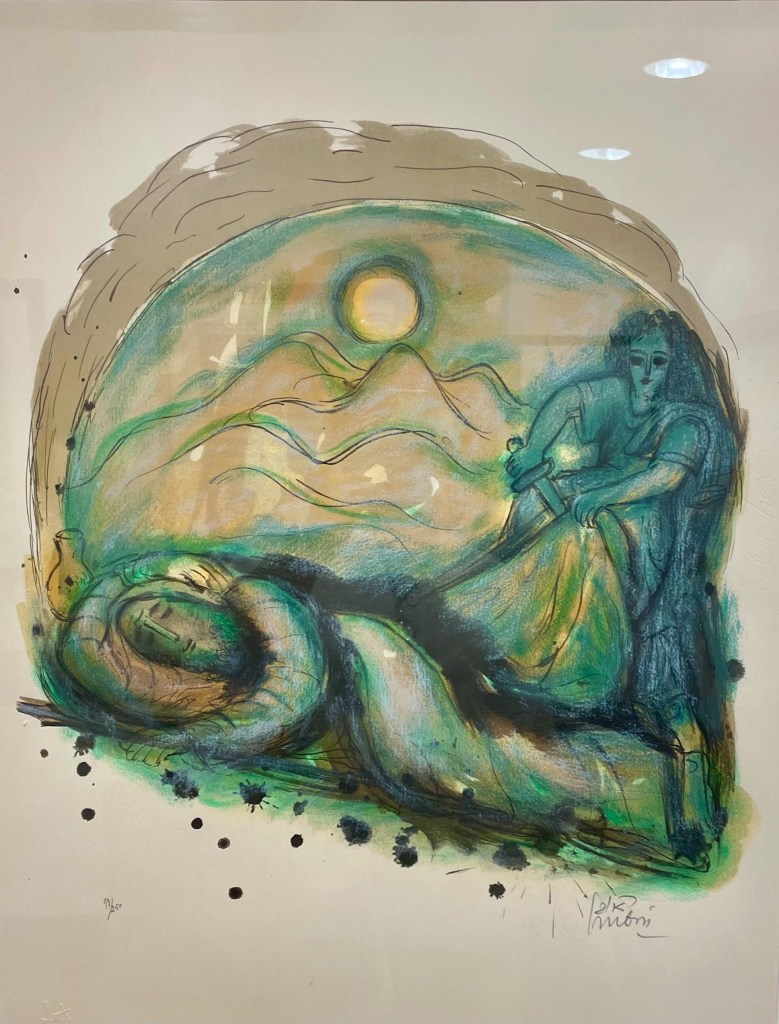
- David went and stealthily cut off the corner of Saul’s cloak.
I Samuel 24:4

- David danced before the Lord with all of his might.
II Samuel 6:14
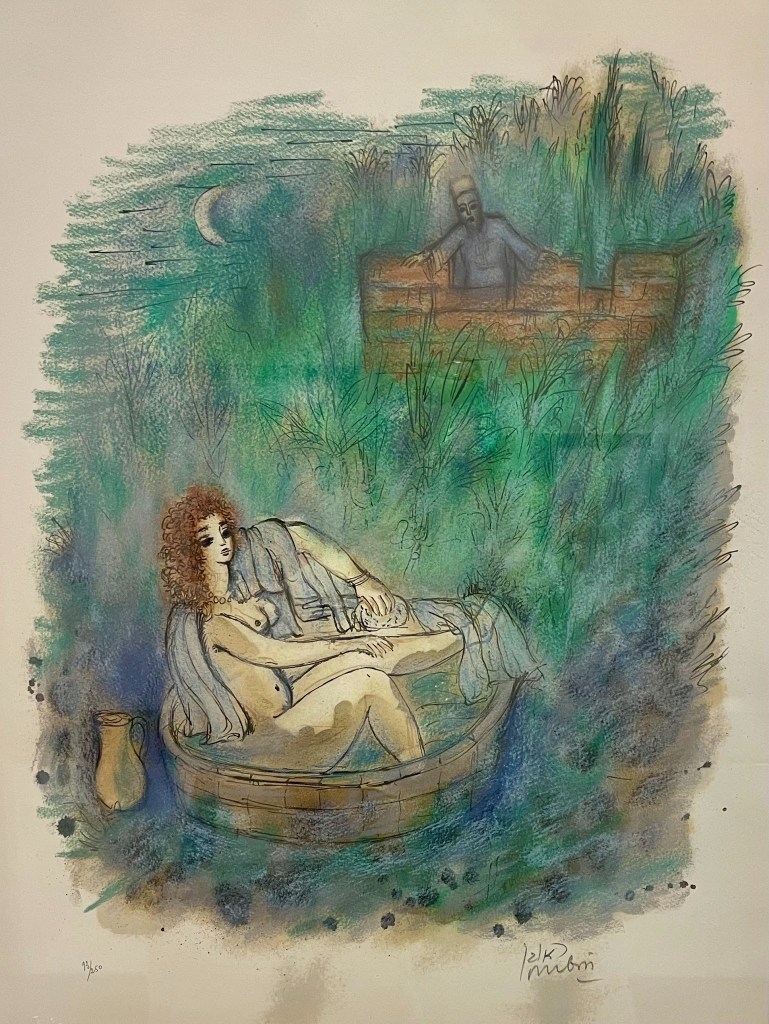
- Late one afternoon, David rose from his couch and walked on the roof of his royal palace. From the roof he saw a woman bathing, and the woman was very beautiful to behold.
II Samuel 11:2

- And he wept…saying…”My son Absalom, my son; my son Absalom.”
II Samuel 19:1

- God sent an angel to Jerusalem to destroy it… but he repented of this evil and said to the angel, “Enough, stay your hand.”…David raised his eyes and saw the angel of the Lord.
I Chronicles 21: 15-16
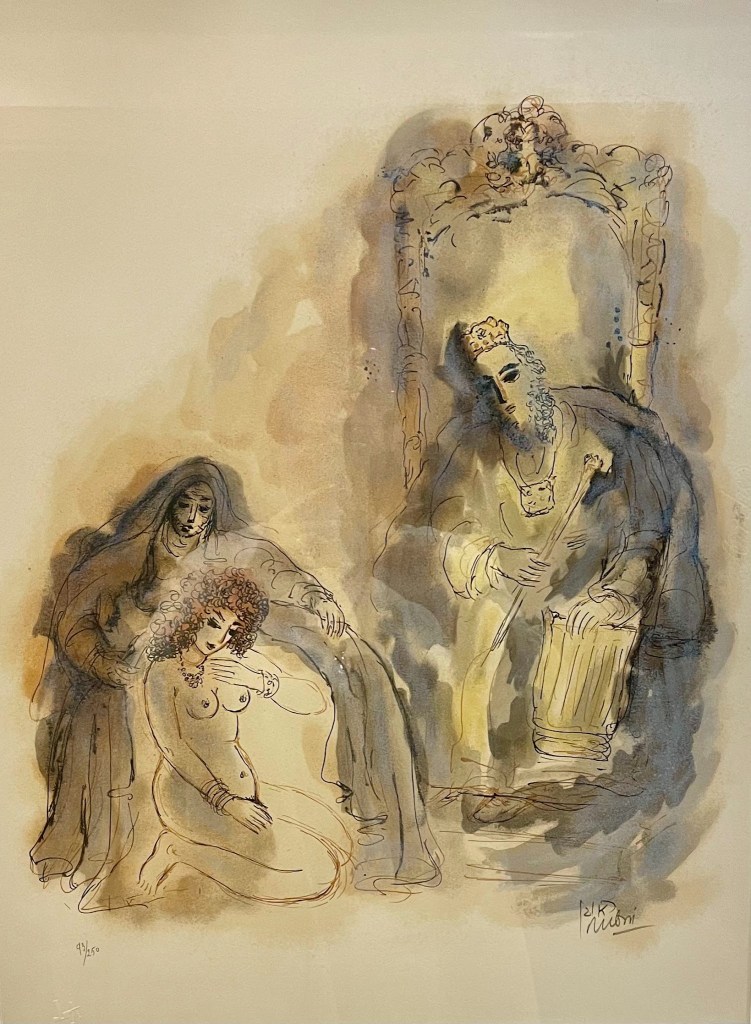
- King David was old and advanced in his years…and he could not warm himself. His courtiers said, let a young maiden be sought…[to warm him].
I Kings 1: 1-3

- My lord, you yourself swore to me, “Solomon your son shall rule after me, and shall sit upon my throne.”
I Kings 1:17

- Our feet shall stand within thy gates, O Jerusalem.
Psalms 122:2
References
Arches-Paper.com. “History-Arches Paper.” May 1, 2024). HISTORY – Arches Papers (arches-papers.com)
Chabad.org
Greenberger, Alex. “The Extraordinary History of Mourlot, Picasso’s Printmaker.” November 6, 2013. ArtSpace.com. The Extraordinary History of Mourlot, Picasso’s Printmaker | Art for Sale | Artspace
Leebhoff, Marti. Modern art by Jews was neither a rebellion nor a revolution: A comparison study of artist Marc Chagall and Reuven Rubin. California State University, Dominguez Hills, 2013.
Mr-Expert.com. “Rueven Rubin.” May1, 2024 Estimation et cote de Reuven Rubin | Expertise gratuite (mr-expert.com)
Pennell, Joseph. Lithography. F. Keppel, 1912.