Photography was a brand-new artform during the Victorian era. People, at first, did not know what to make of it, but then it became a booming enterprise. In Lady Elizabeth Eastlake’s book entitled “History of Photography Part One” she says, “Thus, where not half a generation ago the existence of such a vocation was not dreamt of, tens of thousands (especially if we reckon the purveyors of photographic materials) are now following a new business, practicing a new pleasure, speaking a new language, and bound together by a new sympathy.” I believe the most interesting information about Victorian photography from the articles was that while photography was not considered art per se, it was considered to be an important genre for recording information. A person would get ready and choose every item carefully for a portrait to be painted, but conceivably, a picture could be taken on impulse. In this way, memories are recorded that would never have been saved, otherwise. Baby shoes, a pet, and even the weather make incidental appearances in pictures when everything in a painted portrait is planned to precision. In the article, “History of Photography Part Two”, Lady Elizabeth Eastlake explains that “…[photography’s] business is to give evidence of the facts as minutely and as impartially as, to our shame, only an unreasoning machine can give.” In postmortem photography, which seems morbid and outrageous today, families found a niche in Victorian society because people needed a way to memorialize a loved one quickly, and a painting could never work in this way.

In general, the Victorians were nearly obsessed with death and the afterlife, and so they looked for other ways that photography could further this interest. This is where the ghost and seance type photographs came from. During this time, it was inconceivable that a photographer could find a way to commit fraud by changing a photograph in some way, so these spiritual photographs were a sensation.

There were also the Cottingley fairy photographs that showcases this same idea that photographs were irrefutable proof and could not be faked. This was an incredible hoax that became very popular.

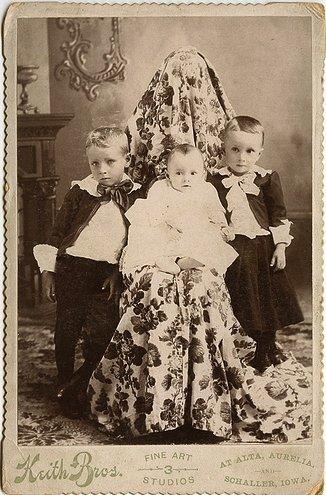
There was also the strange genre of hidden mother photographs, which are always kind of funny. The mother sits with a child or children on her lap, presumably so that they will sit still and cry, but a blanket is thrown over her head, so she is “hidden” in the photograph. She is never really hidden, though. She just looks like a fabric mountain. It would have been better to just include the mother.
Over time, however, people became more and more familiar with photography and its possibilities and more relaxed in their picture poses. It is fun to remember, though, how far we have come since the advent of photography. Victorian photography truly is a snapshot of that time frame.
“Photography,” by Lady Elizabeth Eastlake, from The London Quarterly Review, No. 101, April 1857, pp. 442-468.
Post-mortem Photography in the Victorian Age: When Life is a Fiction. – Eikona
Cottingley Fairies: How Sherlock Holmes’s creator was fooled by hoax (bbc.com)
Hidden mothers in Victorian portraits | The Museum of Ridiculously Interesting Things