

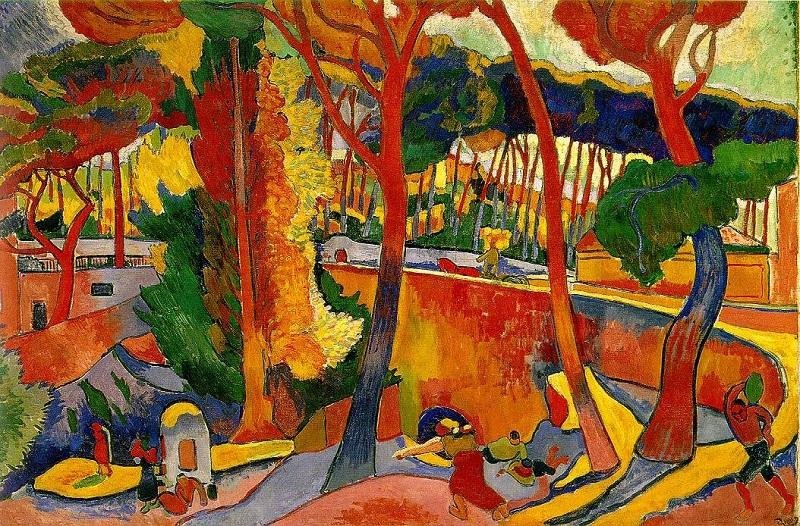
Andre Derain, a French painter and one of the founders of the short lived Fauvist movement, painted a color charged scene of the French countryside named “The Turning Road, L’Estaque” in 1906. This painting was created in what was the last few minutes of an art movement that lasted only between 1901 and 1906 and expresses all that fauvism has to offer in the boldest and most colorful ways. Although Derain is not as well known as Fauvism’s other co creator, Henri Matisse, Andre Derain created such a powerful statement with color and shape in “The Turning Road” that the painting has become a lasting symbol of the entire Fauvist art movement. Derain’s painting is a brilliant example of all that Fauvism has to offer and is the perfect bridge between Impressionism- Post Impressionism that showcases real but ethereal images and Expressionism-Cubism that abandons reality altogether for surreal and often haunting images.
This painting is large, over four feet tall and over six feet wide. It is alive with bright reds and oranges, and in the shadowy areas, purples and deep greens. Derain’s “The Turning Road” showcases the feelings of the place, and is a subjective idea rather than being a recreation of that place on a particular afternoon. Just a few years earlier, Paul Cezanne painted the exact same area of L’Estaque, which is part of Marseille, France, and that painting makes a much different impression than Derain’s work on the same subject. Cezanne uses soft colors and blurry lines, while Derain makes bold strokes with big splashes of color. In Derain’s painting, the trees sway, as if they are dancing, and the colors are so intense, it is as if they are on fire. There are people in the scene of Derain’s painting, but they are so devoid of individualism that they only remind the viewer that people exist in this place without going into too much detail. For Derain, it is the landscape that is the star of the painting. Without being told, it would be difficult to know that both of these paintings are of the same area. This small area of France had not changed between the two paintings, what changed instead were the painters.
What would possess a handful of painters to move from Impressionism, then Post-Impressionism, each an art movement that celebrated unreal and dreamy images and then go a few steps “fauver” (farther…) right into Fauvism? This change coincided with cultural changes in the world at this time. During Impression-Post Impressionism, it was the last years of Queen Victoria’s reign. There was optimism and industrialism. However, by the time that Fauvism and Andre Derain came along the world had changed. The longest reigning monarch at the time, Queen Victoria had died and all of the ills of industrialism and modernism had begun to take effect. People had become less optimistic and more discouraged and it showed in their artwork. The art was now less about what something actually looked like, but instead what it made the artist feel like that made it on the canvas. This is where the extreme use of color and abstract, almost too simplistic way of painting objects, comes into play. You know the depth of emotion of the artist by studying the color choices that were made. Cezanne chose muted soft colors in his painting of L’Estaque, while Derain chose the most vibrant reds and oranges to convey the aliveness of the same area.
Fauvism, although a short art movement, was important to show the changing sensibilities of artists at this time, and also the changing sensibilities of the world at large. Everyone was feeling somewhat lost with all of the ways that the modern world was changing. Andre Derain painted how he and others felt, alive with emotion, but also with a sense of disbelief. “The Turning Road, L’Estaque” by Andre Derain is not only his best loved painting, but also one of the crowning achievements of the Fauvist movement.
Andre Derain”The Turning Road, L’Estaque”
Paul Cezanne “L’Estaque- The View Through the Pines”



1 Comment
nonmacher
Oh baby this is good stuff!