

When speaking about Judaic art, you cannot start at the beginning. It would take too long! Instead, the best place to start will be near the end of the nineteenth century. This is the time in history that Zionism was beginning to gain real traction. Zionism is the belief that Jewish people have a God given destiny to inhabit the land in the Middle East known as the Holy Land. Since the Temple was destroyed in 70 CE, the land in Palestine has been in influx. Parts of the area, though, like Safed, had been steadily working, fundraising and raising awareness for Zionism’s cause through art.

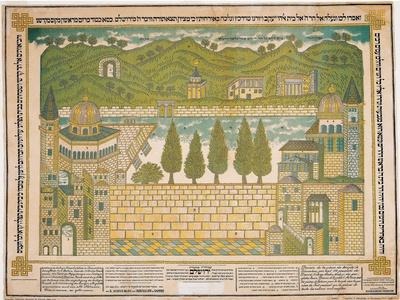
A great example of this type of art was made by Rabbi Schmuel Schulman around the year 1895 in Safed. He was working as a scribe while making micrographies for the tourist trade. Micrographies are art pieces where all of the art is made up of tiny Hebrew text. This artform was originally done between the ninth and eleventh centuries and was nearly exclusively a Jewish artform. Rabbi Schulman in Safed created “The Temple Mount” micrography. Composed of all tiny text, the art piece comprises all 150 Psalms, portions of Prophets and Lamentations and the Song of Solomon. The centerpiece of the artwork are five cedar trees placed in the center of the Temple Mount. This is full of symbolism because the cedar tree is believed to be the wood used in the construction of both the first and second temple built on the Temple Mount. Placing the trees on the mount is code for Judaism preparing the wood for the construction on the Temple Mount once again. Selling these lithographs and others like this, was stoking the flames of Zionism in the Jewish people and the tourist trade throughout Jerusalem, Safed and beyond.
Theodor Herzl (shown below) recognized as the Father of Zionism, held the First Zionist Congress in Switzerland in 1897. By the sixth Zionist Congress in 1903, he was championing the idea that Jews could find refuge in British east Africa, but this met with opposition from many sides. Jews by and large wanted to return to the Holy Land and were not interested in making a Jewish state in any other place. Theodor Herzl died the next year, in 1904, but his work promoting a Jewish homeland had begun to take root with others.
This is the environment that Boris Schatz (shown below), founder of the Bezalel School of Arts and Crafts, found himself in. There was a growing sense of discontent and at the same time hope among the Jewish people that they could regain what was lost. Boris Schatz felt keenly that he, like Theodor Herzl, could be instrumental in the Jewish people repopulating their homeland. So, in 1906, Boris Schatz began the Bezalel School of Arts and Crafts. Schatz would use art as a strategic tool to inspire the Jewish people, to raise awareness of Zionism, and to raise funds through the sale of the art to fund Zionism. His big idea was to do all of this through Art Nouveau.


- Temple Mount Micrography
- Parchment paper
- 1895, Safed Israel
- Rabbi Shmuel Schulman


