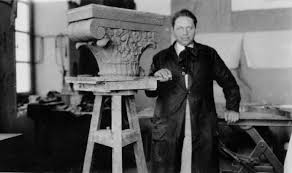
Born Wolf Rawicki, Ze’ev Raban was born on February 12, 1890, in the town of Lemberg, which is now in the area of the Ukraine. Ze’ev’s family were a devout Jewish family. He was artistic from a young age and would later grow up to become one of Judaica’s most loved artists. He received formal art training at the Academy of Fine Arts in Munich, Germany. During his time in Germany, Ze’ev Raban was exposed to the Art Nouveau movement, which would later be a major influence on his own work at the Bezalel School. Raban arrived at the Bezalel school in 1912, when he was only 22 years old. By 1914, Raban was head of the Repoussé Department. Some scholars argue that it was Raban and not Boris Schatz who was chiefly responsible for Bezalel’s artistic aesthetic. Researchers argue that while Schatz had a vision of what he wanted the Bezalel school to be known for, it was Raban who was able to implement that vision and make Schatz’s dream come to life.

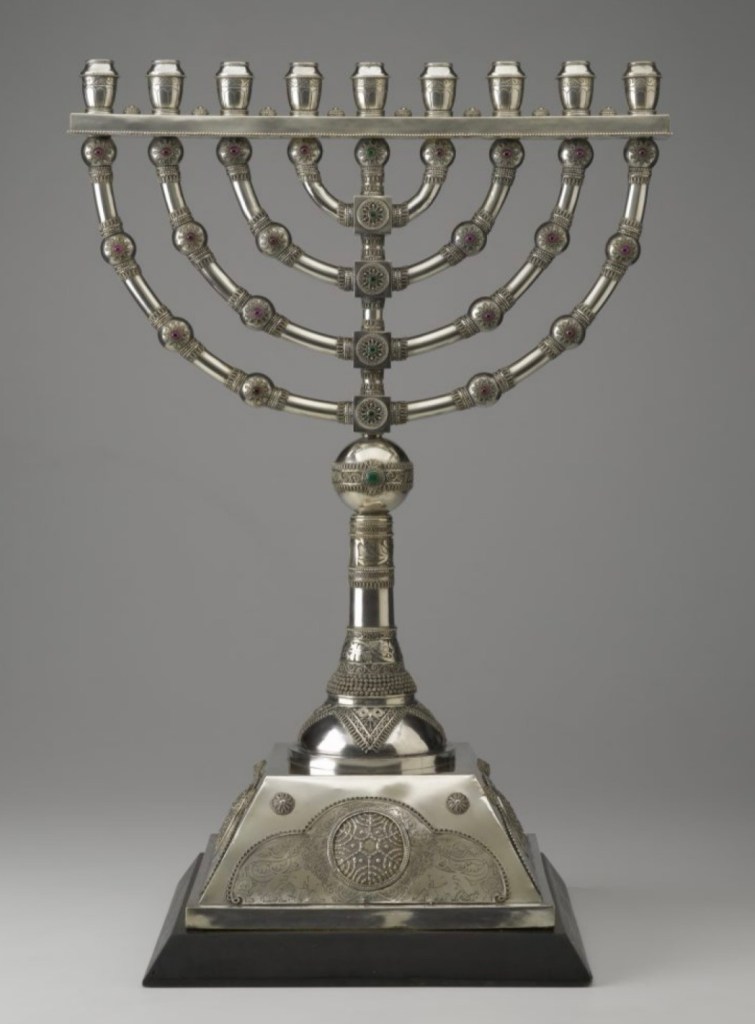
Raban taught painting at the Bezalel school using the plein air method, painting outside in the open air, which was a popular method at the time. Raban is famous for both his painting and metalwork. In fact, at the Bezalel School, Raban was the Director of the Repousse Workshop and a teacher of Anatomy and Decorative Arts. In the Hanukkah lamp below, Raban uses the fluid lines of Art Nouveau, emphasizing curves and the organic styling of the movement, while showing his metalworking skills.
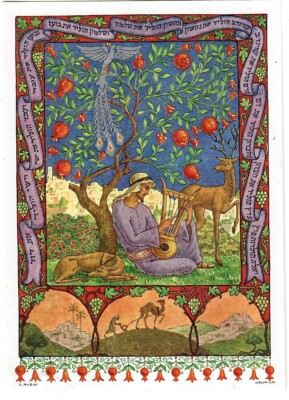
Raban believed that the art being produced by nearby Arab cultures and Jewish communities were the closest art to what would have been produced by the ancient Hebrew people. He wanted to take these styles and marry them with the Art Nouveau movement to create a lasting movement and art tradition. Raban was interested in symbolism more than realism. It was more important to him to paint an archetype of a woman than a particular woman. The same goes with the world. He would have rather painted a beautiful landscape in his head, than one he had actually seen. The way that he depicted the stories of legendary figures from the Bible was to give them an almost mythological status of importance.

Ze’ev Raban died in 1970 after nearly 60 years of making art in support of Jewish culture. He had gone blind and was suffering the effects of Parkinson’s disease. Raban was buried in Jerusalem at the Har HaMenuchot cemetery, Mount of Those Who are Resting. Below is a poster that Raban designed around this timeframe.
Goldman-Ida, Batsheva. “Boris Schatz, Abel Pann and the Bezalel School of Arts and Crafts in Jerusalem.” Menotyra 27.1 (2020)
Jew Age.com. “Ze’Ev Raban- Biography.” 2024.
Yekkes, Adrian. “Ze’Ev Raban: Painter, Illustrator and Father of Israeli Design.” adrianyekkes.blogspot.com. February 7, 2012.