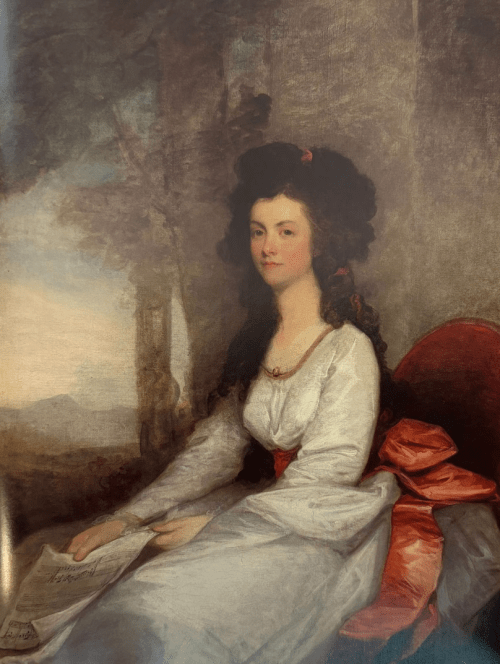
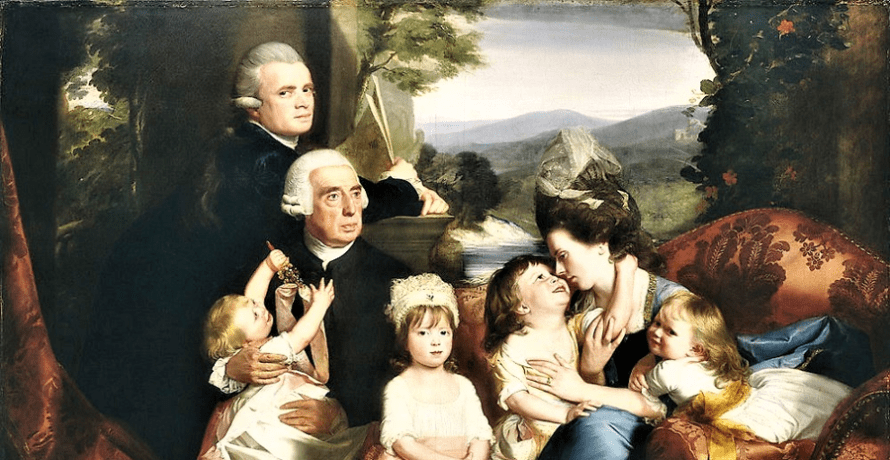
From the mid to late 18th century, Sir Joshua Reynolds was the premier portrait artist in England. Reynolds, long-time President of the Royal Academy, consummate art educator, and author of “Discourses” would have been familiar to Trumbull from his time spent studying art under West in London. Reynolds had much to say about the theory and practice of portraiture, and how it differs from other paintings. Reynolds in “Discourses,” described the mindset well. In history painting, the artist is depicting a generalized man throughout the painting. Unless it is a man of historical significance, there is only a generalization of the features. Portraiture has the opposite purpose. A person will have all their singularities recorded to produce an individual likeness and is in essence a “defective model.” Many times, a history painter who also does portraiture can fall more into one category than the other. In all the artist’s history paintings, the men are all so specific that it is distracting, or in their portraiture, the sitters all look so similar as to be difficult to tell them apart.
Reynolds records that there is a hierarchy of paintings, beginning with a still life. The painting of fruit and flowers, while it does involve skill with technique, color, shadows, and light, is not as technically difficult as portrait painting. According to Reynolds after still life painting is portraiture, then history painting is technically more difficult than still life and portraits. Reynolds allowed that portraits are easier to create, and how he has spent most of his time. However, that does not mean that portraiture should be without greatness. The genre is less dignified, but it is the details and embellishments that make a portrait special. It is said that when Reynolds painted people’s portraits “his men are all nobleness, his women are all loveliness and his children are all simplicity.” The problem with his portraiture is that men and women of means could buy a flattering pose. Reynolds was more than happy to accommodate them and was well known for his flattering portraiture.
Reynolds was aware of his tendency to flatter. He wrote on the character of portrait painting emphasizing how it is the artist’s responsibility to imbue the sitter with the qualities that they possess and not just the qualities that complement. For example, a battle-torn war veteran would give, just by gazing at his portrait, the feeling of bravery or patriotism. A mother and child would exude love or tenderness. Imbuing a portrait with perceived qualities could descend into “presumptive loftiness” but Reynold’s idea was correct.
In private portraiture, as such with Reynolds, he believed that people would gaze upon their portraits during their lifetime with interest, but then the next generation would have moved on. Thus, the portraits would have lost their meaning. Reynolds explained this problem, “The face of an undistinguished person, however exquisitely painted, is disregarded in the eyes of posterity.” This is why it was necessary for a serious painter to not concentrate solely on portraiture, because the glory and prestige do not last. Reynolds said, “The painter who wishes for lasting fame must not lavish his fine colors and his choice postures on the rich and the titled alone; he must seek to associate his labors with the genius of his country.” Reynolds was wrong on this point, however. He is correct that historical paintings do maintain interest for viewers throughout generations, but he was wrong that individual portraiture would lose its significance. Individual portraits are now as important as historical paintings because they both inform the viewer of history and culture.
Even though portraiture can be both for a private and public audience, most portraits, in the beginning, are intended for a private domestic audience. Reynolds explained that even though portraits can be private, over time they take on more of a public historical persona. This is especially true when the portrait is of someone of importance like a statesman. As these portraits become part of the official record of the person who has passed, these paintings can be an avenue to know and understand a person better than just through documents. Sometimes, a portrait can be the only historical record historians have.

Sir Joshua Reynolds. Self Portrait 1749. London, England.
Reynolds painted several self-portraits over his lifetime. Reynolds completed a self-portrait when he was still a young man of twenty-six. In this portrait, Reynolds is shielding his eyes with his hand, which places a shadow over his face. He is looking past the viewer with a slight frown on his face. He is holding in his hands a Porte-crayon which is a writing instrument that holds charcoal, chalk, graphite, etc. This painting gives the impression that he is gazing past the viewer to get a better look at what he is drawing. He is an artist painting himself as an artist. He is wearing a brown coat over a white shirt with the frilly cuffs exposed. He has his brown hair worn in loose curls about his head. The background is only a dark muted color.
Later, Reynolds would paint another self-portrait. Now he is older, the year is around 1780, and he is in his mid-fifties. This portrait is not about “becoming” like his earlier portrait. Instead, this painting celebrates what he has become. In his hand he holds an honorary Doctor of Civil degree from Oxford. He is wearing the academic robes from Oxford, as well. Beside him is a bust of Michaelangelo. Reynolds is proclaiming both his intelligence and his artistry in this portrait.

SIR JOSHUA REYNOLDS. SELF PORTRAIT 1780. LONDON, ENGLAND.
Both self-portraits are studies of how the man, at different stages of his life, was willing for people to view them. Reynolds is proclaiming his own historical legacy by illustrating how he hoped people would remember him. These portraits do not just showcase his talents; they showcase an artist creating his own legacy.
Reynolds, Joshua. The Life and Discourses of Sir Joshua Reynolds. Sawyer, 1853.
Jones, Robert W. “Joshua Reynolds and Deafness: Listening, Hearing, and Not Hearing in Eighteenth-Century Portraiture.” Oxford Art Journal 46.3 (2023): 357-377.