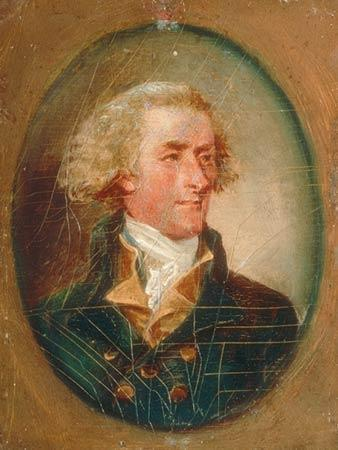
Gilbert Stuart, like Trumbull, studied under West. Several stories have circulated as to how Stuart became a pupil of West. One story has Stuart send a letter to West imploring, “Pity me Good Sir, I’ve just arrived at the age of 21 an age when most young men have done something worthy of notice & find myself ignorant without Business or Friends, without the necessaries of life…” This story, whether true or not was a good representation of the outgoing personality of Stuart. West took Stuart as a student and soon Stuart was a resident assistant helping West to finish draperies and backgrounds on what Stuart called West’s “ten-acre pictures.”
Stuart stayed under the tutelage of West for a decade. As time went on, Stuart began to follow more and more his artistic instinct and influences from other painters. Artists like Reynolds and George Romney inspired Stuart to take his artistic style in a new direction. Stuart would also attend Reynold’s discourse at the Academy and had several paintings of his own in its annual exhibits. West did not discourage Stuart from his own ideas so long as Stuart continued to paint in West’s own style when called upon to work on one of West’s canvases. This situation could have gotten tense between Stuart and West, if not for another young pupil, Trumbull, to appear in 1780.
Stuart was soon able to move down the street from West and set up his studio. There he was able to have portrait patrons of his own. People unwilling to wait for West or unwilling to pay the higher price could sit for Stuart. Soon, though, money was short for Stuart. One day, three men, Isaac Barre, John Jervis, the Earl of St. Vincent, and Hugh Percy called unexpectedly on Stuart in his studio. They explained that they understood that money was a shortcoming. To remedy this, they would each sit for portraits, but that Stuart should make it a rule that the first sitting for a portrait must be half price. Stuart would follow this rule from then on. Between this new sales ploy and his new connections, Stuart’s portraiture became successful. Later, in 1828, a student of Stuart’s named John Nagle remarked about his mentor, “His object was to counterfeit the soul – to throw the intelligence of expression into the face of the picture – to catch the thoughts… the disposition, and with such elegant touches, that at a glance his copy is sufficient to afford an understanding of the mind of the original.”
Later Stuart married Charlotte Coates. There are no records of him painting Coates’ portrait but there is a suspected portrait of Coates by Stuart. [5] In 1783-1785, George Romney painted a portrait of Charlotte Clive. Stuart working in proximity to Romney would have had the opportunity to see and work from this painting, as it sat in Romney’s studio for two years. Scholars believe that Stuart did his own version of the Charlotte Clive portrait that is now titled, “Eleanor Gorden.” There is some speculation, though that Stuart’s model for this portrait was his wife, Coates. First, the painting is said to bear a striking resemblance to his wife. Second, Stuart has added a detail of the music sheet. Coates, being an accomplished musician, would merit such an addition. Stuart and Coates had a daughter named Jane. The younger Stuart was an artist and portraitist in her own right. When asked about this painting, Stuart’s daughter replied that it was “a beautiful picture of a very lovely woman.” Possibly hinting that she was aware that the portrait looked identical to her mother. While there are stories of a portrait that Stuart painted his daughter in a white dress, it is unknown what happened to this portrait.
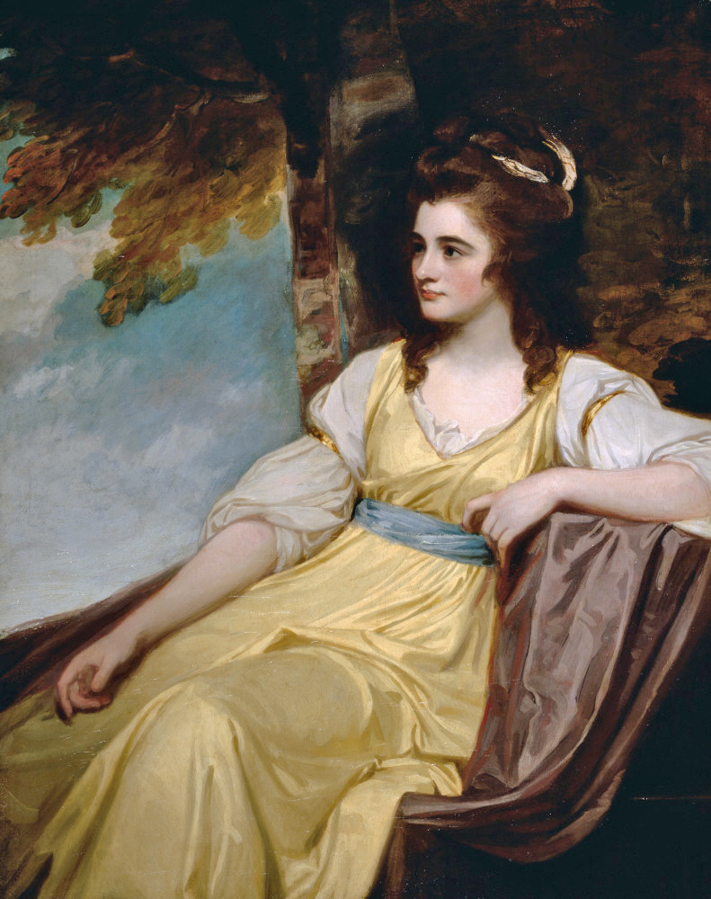
GEORGE ROMNEY. CHARLOTTE CLIVE. 1783-1785. ENGLAND
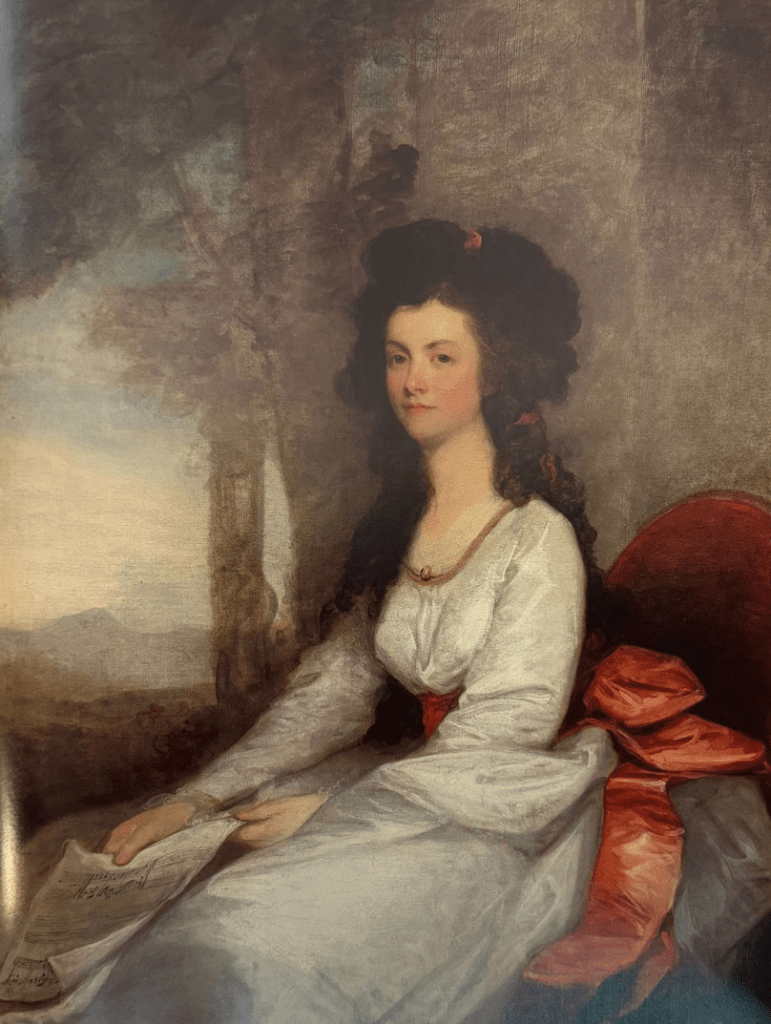
GILBERT STUART. ELEANOR GORDEN. 1783-1784. LONDON, ENGLAND
Stuart would often chat along endlessly with his sitters to keep them comfortable and animated while painting them. One researcher believes that the reason why Washington looks so melancholy in Stuart’s famous Vaughn painting is because Washington was bored with Stuart’s constant conversation. The Vaughn painting was commissioned as a gift for Samuel Vaughn from his son John Vaughn. At the same time, Vaughn also paid for Stuart to paint a portrait to be made of himself. John Vaughn was still a young man when he commissioned this gift and it is often cited that this was a gift from the father to the son, which seems a more likely scenario. Both paintings are very similar in tone and style.
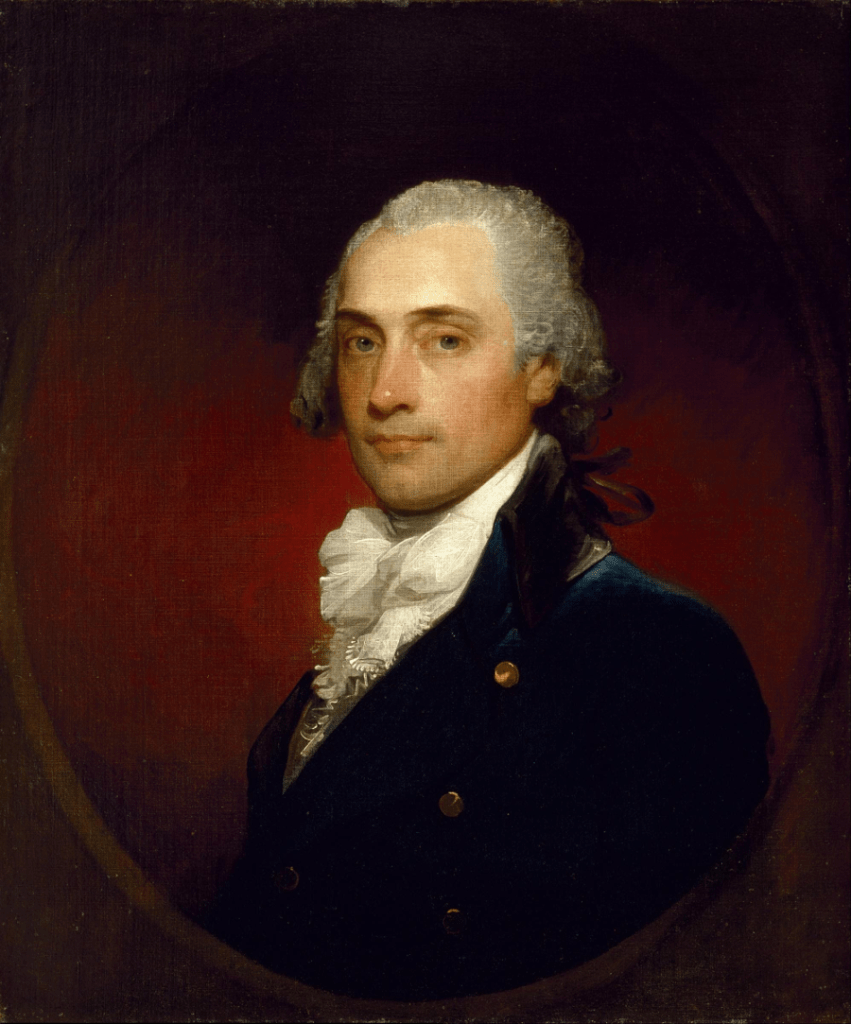
GILBERT STUART. JOHN VAUGHN. 1793-1797. PHILADELPHIA, PENNSYLVANIA.

Gilbert Stuart. George Washington (Vaughn Portrait) 1793-1797. Philadelphia, Pennsylvania.
Trumbull sat for a portrait twice for Stuart. The first time, the two artists, Trumbull and Stuart, were working in concert with one another in West’s studio. In 1779, George III commissioned thirty-six biblical scenes from West that Gibert Stuart and Trumbull would help with. In the painting “Moses with the Tables of the Law”, in thanks for their hard work, both Trumbull and Stuart inserted themselves in West’s painting. Trumbull is on the left side, and Stuart is on the right.
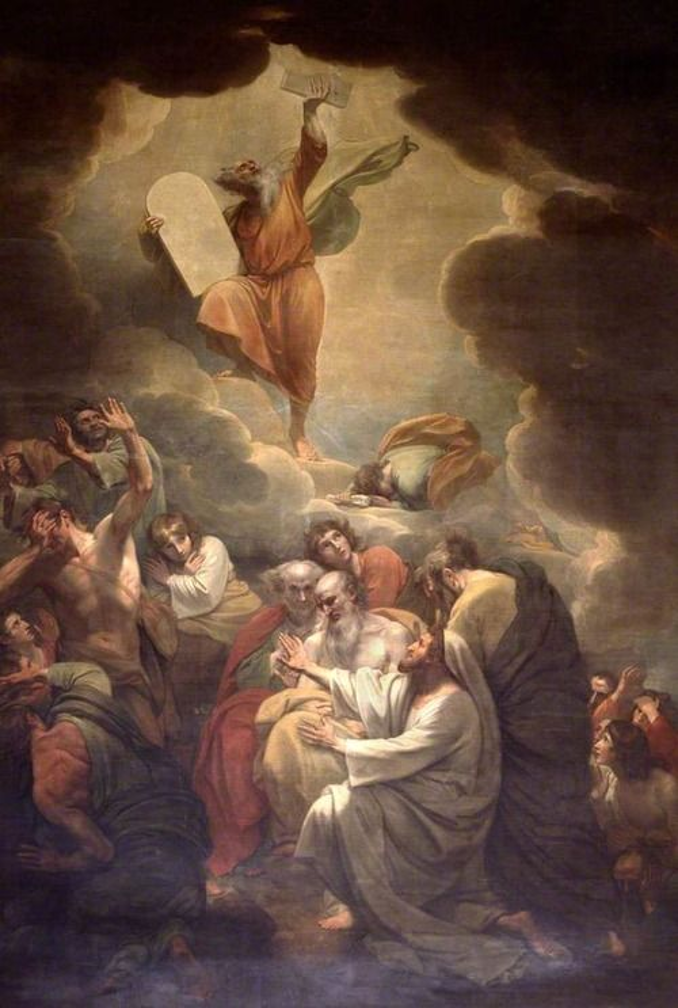
BENJAMIN WEST, MOSES WITH THE TABLES OF THE LAW, 1779, LONDON, ENGLAND.
During this period, Trumbull also completed the painting of a full-length portrait of Washington overlooking a bluff. Then, when the painting was completed, contracted to make prints to sell to fund relief for American soldiers who were being held as prisoners on British ships. This painting of Washington became so popular that it began showing up in prints across Europe, in Belgium books, in French history publications, and Irish magazines. This same portrait even became part of a scenic toile design for wallpaper and bed hangings.
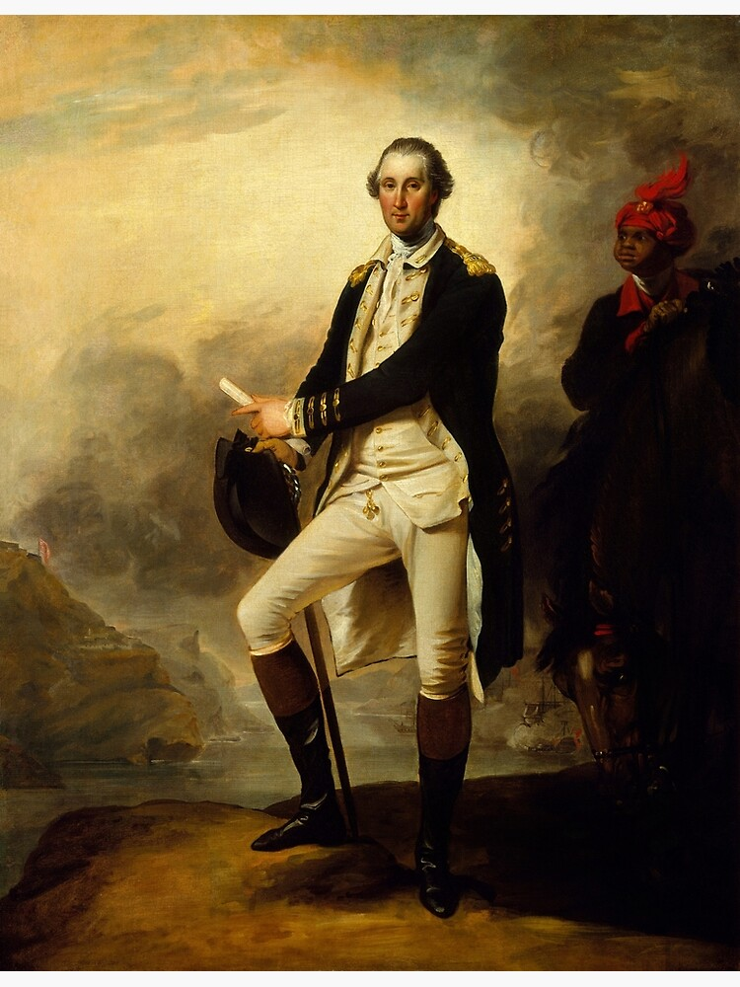
JOHN TRUMBULL, GEORGE WASHINGTON, 1780, LONDON, ENGLAND.
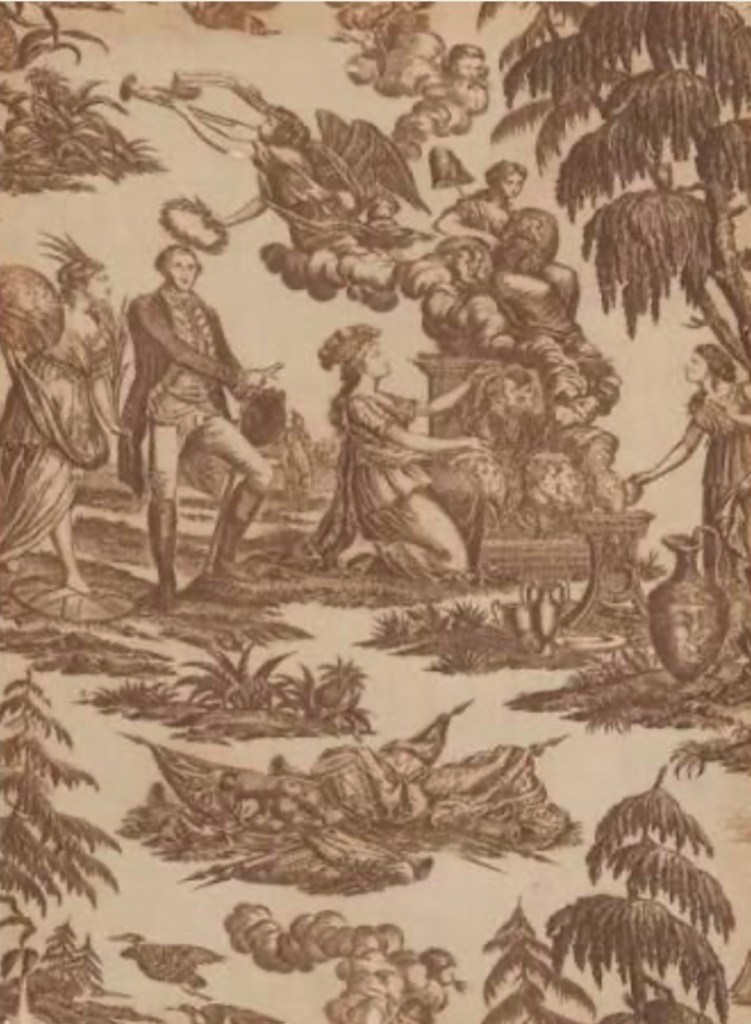

UNKNOWN. TOILE FEATURING GEORGE WASHINGTON POSSIBLY FROM JOHN TRUMBULL’S PORTRAIT. 1780’S.
During this period, Trumbull was imprisoned as a suspected spy. While in jail, Trumbull spent his time painting. His friends would visit him and bring him projects to keep his mind sharp and his spirits high. It was during this time that Stuart painted the first of his two paintings of Trumbull. Stuart would often visit and would address Trumbull as “Bridewell Jack” or “Notorious Murderer” or some other similar name as a joke for Trumbull’s pompous nature. Stuart painted only Trumbull’s face in profile. The rest of the painting, Trumbull’s shoulders, his shirt, coat, and ruffle were all painted by Trumbull. In the background is a window and if you look closely, you will see the bars, indicating that Trumbull was still an unwilling resident of Bridewell at this point. Trumbull truly loved this painting by Stuart, though, as he felt that it captured an important season of his life.

GILBERT STUART, JOHN TRUMBULL, 1780, LONDON, ENGLAND.
After some months, even with the threat of execution, in June of 1781, Trumbull was released from Bridewell prison. There was $400 bail that would be paid. Trumbull had come up with half, West contributed $100, and Copley contributed the final $100. Other conditions were that Trumbull must leave England within thirty days, which he did promptly.
Trumbull’s favorite portrait of himself was the portrait that Stuart painted of him while he was in jail. One day, Anne, a daughter of Stuart, visited Trumbull in 1843. She said, “He was sitting at his easel, with the picture before him, which my father had painted of him in London, but looking depressed and very much broken. The moment he recognized [Anne] he started from his seat, exclaiming, ‘Good God! The spirit of your father has been hovering over me! I cannot tell what has possessed me, but I have been thinking about him all morning and of the many happy days of our early friendship. This it was that induced me to place the picture on the easel.” Trumbull’s preference for the earlier painting of him in jail was likely the melancholy remembrances of youth and the romanticism of his early days. Of the later painting by Stuart, Trumbull’s gift to Harvey, Trumbull says, “In truth, I never liked it. It had to my Eye something of a pert & methodistical look – which I am not conscious of possessing.” After Harvey died in 1824, he regifted the painting to his friend, Dr. David Hosack, a prominent New York City doctor and professor at Columbia College.
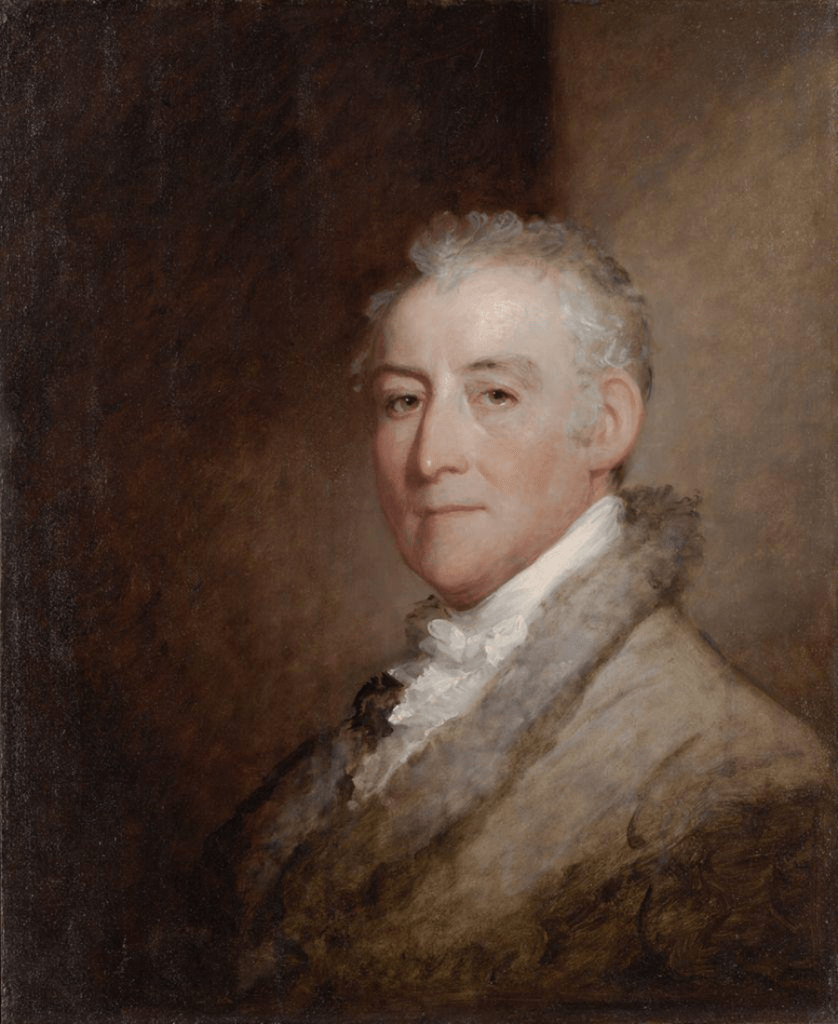
GILBERT STUART, JOHN TRUMBULL, 1818, UNITED STATES.
Barratt, Carrie Rebora, Gilbert Stuart, and Ellen Gross Miles. Gilbert Stuart.
Gilbert Stuart Museum. “Art Gallery.” Gilbert Stuart Museum, https://gilbertstuartmuseum.org/art-gallery/.
Mason, George Champlin. The life and works of Gilbert Stuart. C. Scribner’s Sons, 1879.
Museum of Fine Arts, Houston. Portrait of John Vaughan (1756–1841). eMuseum, John Vaughn.
Staiti, Paul. Of Arms and Artists: The American Revolution through Painters’ Eyes.
McLanathan, Richard BK. “Gilbert Stuart.”
Brookhiser, Richard. Glorious Lessons: John Trumbull, Painter of the American Revolution.