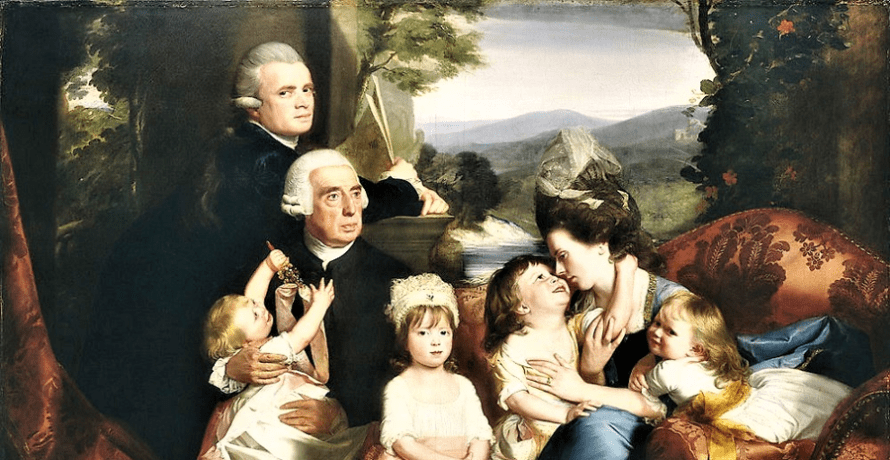
Before John Trumbull was born, John Wollaston was one of America’s earliest portrait painters. Beginning from around 1749, Wollaston was a prolific portrait painter. Some researchers say there are at least three hundred portraits suspected to be by Wollaston, while others say there are only two hundred portraits. Officially, there are about seventy-five portraits credited to him. Wollaston would accomplish these portraits in about a seventeen-year period.
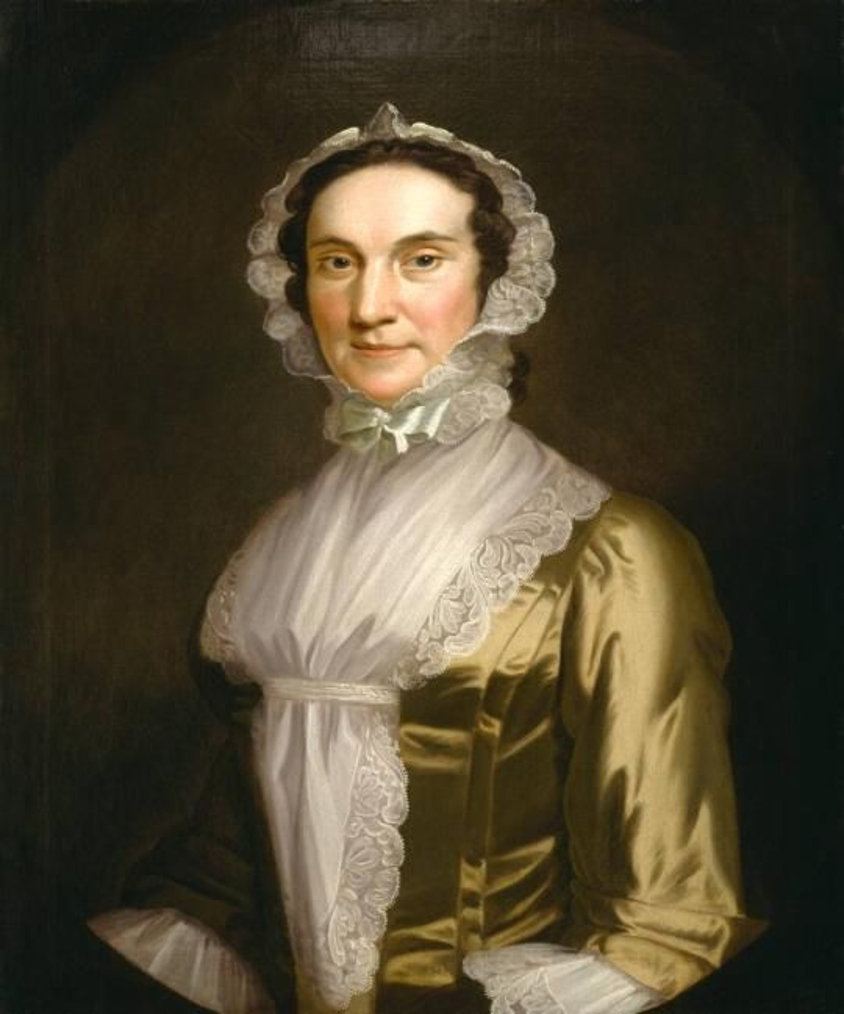
JOHN WOLLASTON. MARGARET TUDOR. 1749. NEW YORK, NEW YORK.
Wollaston’s portraiture includes its peculiarities and can be easily recognizable by the way his sitters all have nearly the same pose and eyes giving what William Sawitzky describes as an upward eye tilt.” He favored some standing poses over sitting poses, presumably because they would be easier to paint with less creases in the fabric of the coats and dresses. He preferred to paint hands either out of sight or similarly with a few certain poses that he could paint quickly and accurately, such as all but two fingers placed within a jacket for men and holding a fan for women.
Wollaston painted in the major cities of the Atlantic seaboard for almost twenty years. One of the first works that Wollaston is credited with is dated 1749 and is from New York. Although there is no signature on the painting, on the back there is the name of the sitter- Mrs. Margaret Nicholls (Margaret Tudor), fifty years old and the year. This portrait showcases all of Wollaston’s trademark tools. The eyes are hooded and slightly slanted. Tudor is standing at a slight angle, and her hands are tucked neatly out of sight. She wears a champagne-colored satin dress. This portrait was likely meant to be passed down Tudor’s family line on personal display.
There is a second portrait painted by Wollaston between 1765 and 1767. The portrait is of a young boy, named William Holmes, in an embrace with a small dog. This portrait is a departure from Wollaston’s earlier work. It is warmer. It even shows a little dog being hugged by the boy. Holmes is not more than five years old in this portrait. He is wearing a buff-colored jacket with a pink silk waistcoat. The curvature of his arms suggests that he is wearing a busk. Between Holmes’ warm demeanor and the look of love on the dog, this is a portrait full of emotion. This portrait is an example of Wollaton’s later portraiture, often painted in the South, where there are often sentimental items, like a puppy, placed with the sitter.

JOHN WOLLASTON. WILLIAM HOLMES. 1765-1767. CHARLESTON, SOUTH CAROLINA.
These early portraits of American identity now occupy an important part of art history research. Culture, lineage, and associations can be understood from these early pieces of art. We know what these people value by what is portrayed. A sword in the hand might mean the sitter is a gentleman. A ship in the background might mean that the sitter has earned their living through merchant shipping. [9] What was meant as the calling card of the day now is a historical map of what early Americans held dear.
Museum of Fine Arts, Houston. Portrait of Margaret Tudor (Mrs. Richard Nicholls), 1699–1772. eMuseum, Margaret Tudor.
Sawitzky, William, and Benjamin West. “The American Work of Benjamin West.” The Pennsylvania Magazine of History and Biography 62.4 (1938): 433-462.
Sawitzky, William, and Benjamin West. “The American Work of Benjamin West.”
Weekley, Carolyn Jeanette. John Wollaston, portrait painter: his career in Virginia, 1754-1758. University of Delaware (Winterthur Program), 1976.
Wollaston, John. Portrait of William Holmes (1762–c. 1818/20). c. 1765–1767. Oil on canvas. Bayou Bend Collection and Gardens, Museum of Fine Arts, Houston. William Holmes.
[9] Museum of Fine Arts, Houston. Portrait of Ebenezer Coffin (1678–1730). Attributed to Nehemiah Partridge, c. 1714–1730. Bayou Bend Collection, gift of Miss Ima Hogg. Ebenezer Coffin.