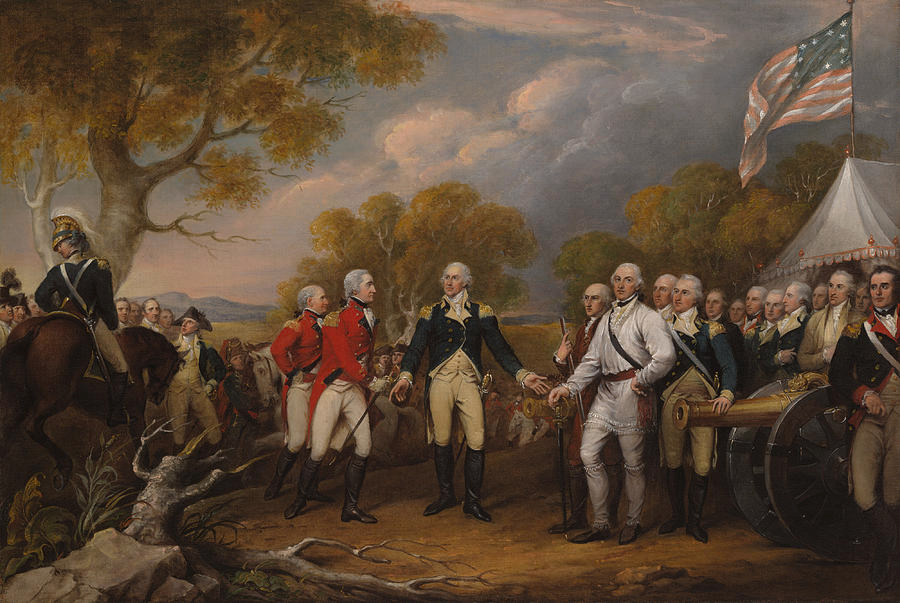
The fourth painting of Trumbull’s that is housed in the Capitol Rotunda is “The Surrender of General John Burgoyne.” General Burgoyne shares the central position with General Horatio Gates of the Continental Army. Authentic to the battlefield, this painting records well what a Revolutionary battlefield looked like, sounded like, and felt like. This is likely because Trumbull did serve in the Revolutionary War under Gates, as well as Washington. Trumbull’s firsthand knowledge of the Revolutionary War gave him an uncommon advantage for the real-life experiences of the battlefield. There are a number of interesting details going on this painting. This painting does not depict the actual battle but the surrender afterwards. Trumbull tooks pains to depict the English with Gates, who is portrayed off-center within the group, not in the front as the main subject of the painting. This could have something to do with Gates and General George Washington not always getting along. Trumbull, incredibly loyal to Washington, might not have wanted to appear that he was giving the same respect to Gates that he had given his hero.
This painting is also important because it marks what many say was the turning point of the Revolutionary War for America. This is because France, seeing the victory, were convinced that America was not a lost cause. France wanted to come and help America, but had been reticent until this battle. Now, fighting on the side of America, it gave France an oppurtunity to strike back at England after France’s loss in the Seven Year’s War.
Trumbull paints a dignified scene. General Burgoyne offers Gates his sword and Gates refuses. This is a way for Gates to give grace to Burgoyne, to treat him like a gentleman and not a conqured officer. Instead, Gates offers for Burgoyne to join him in his tent. This gesture is all about courtesy rather than submission. There a couple of other items of note. The first is that the American soldiers are depicted as orderly and professional. This is in direct conflict with how the English were portraying the Americans- as an unorganized militia. The second item of note is that Trumbull depicted the English standing in formation in surrender. This is give an idea of the scale of this victory, which was enormous! It is estimated that 5000 British troops surrenderd that day.
I was told an interesting story about this painting the last time that I visited the Capitol Rotunda. Apparently, a visitor many years ago, not too long after the paintings were first installed, when no one was looking, actually cut a piece of the painting out near the bottom for a souvenier. This infuriated Trumbull who felt that there should be better security. At that time, the center of the floor was open to the lower level for the eventual installation of George Washington’s tomb. Later, it was decided that George Washington’s tomb would be at Mt. Vernon and the floor was filled in. While the floor was open, though, it allowed moist air to come into the rotunda and this would likely cause damp damage to the paintings. Trumbull had already been complaining about the moist air and now people were actually cutting pieces out of his work! He came back to the rotunda and patched the painting but he made sure that people were aware of his misgivings. This was likely a large part of the reason why Trumbull was not contracted to paint the final four paintings in the rotunda. It had always been assummed that he would do all eight and then, with little warning, four different painters were chosen for the remaining spots.

Last, I just noticed this tonight but the two horses that I saw “whispering and gossiping” to one another in the “Surrender of Cornwallis” by Trumbull have made a similar appearance in this painting. They are not perfectly identical but are still just chatting away with one another! It makes me wonder if the same way that Trumbull always put real people in his paintings to make them more realistic, if he was doing the same thing and putting horses that he knew in real life in his paintings, as well.


Brookhiser, Richard. Glorious Lessons: John Trumbull, Painter of the American Revolution.