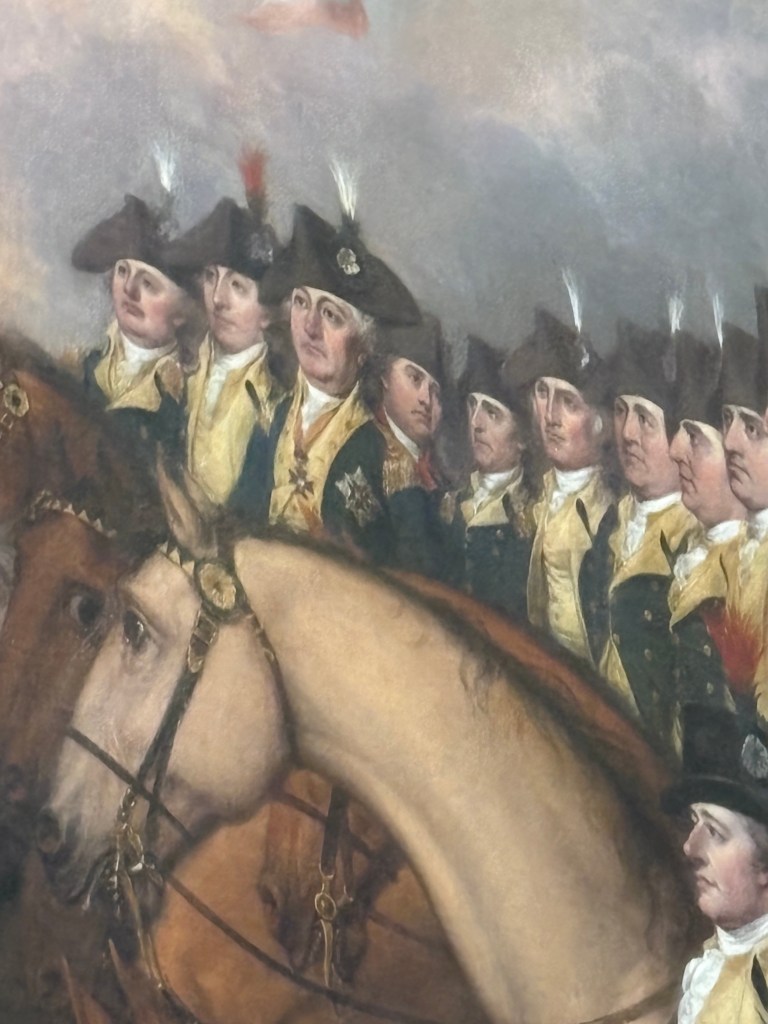
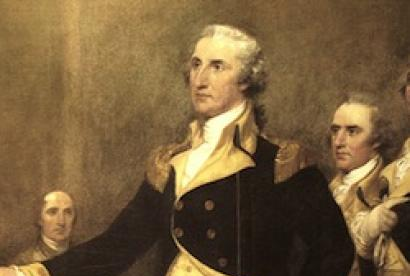
The third painting of Washington by Trumbull to hang in the Captiol Rotunda is called “The Surrender of Lord Cornwallis” and depicts a real event that happened during the Revolution in 1781. This painting confuses people. The first confusing detail is that Cornwallis is absent from the painting that bears his name. The second confusing detail is because George Washington, the colonies’ great hero, is pictured off center, to the right, and somewhat in the background. Significantly, Cornwallis is not in the painting because he had delegated his second in command, Col. Lincoln, for the unpleasant task of surrender, claiming that he was too ill to attend. Washington, not prominent, but present in the action, is portrayed as being a pivotal figure, stoic and in charge, since the very beginning of American history. On Washington’s side are American military officers on the right. On the left side of the painting are Count Rochambeau, Major General Lafayette and the French officers present at the surrender.

John Trumbull, The Surrender of Lord Cornwallis at Yorktown, Virginia, 19 October 1781, 1820, United States Capitol.
The positioning on the painting is important. Trumbull has placed the Americans on the left side and the French, our allies, on the right. This leaves the British defeat squarely in the center. Trumbull, always fastidious with details, depicted as many of the actual men present as possible. Many of these men Trumbull had painted earlier in his career and so was able to reference earlier work to get their faces correct. One notable face in the crowd of American officers is Alexander Hamiliton. He stands within the group of officer to the left.
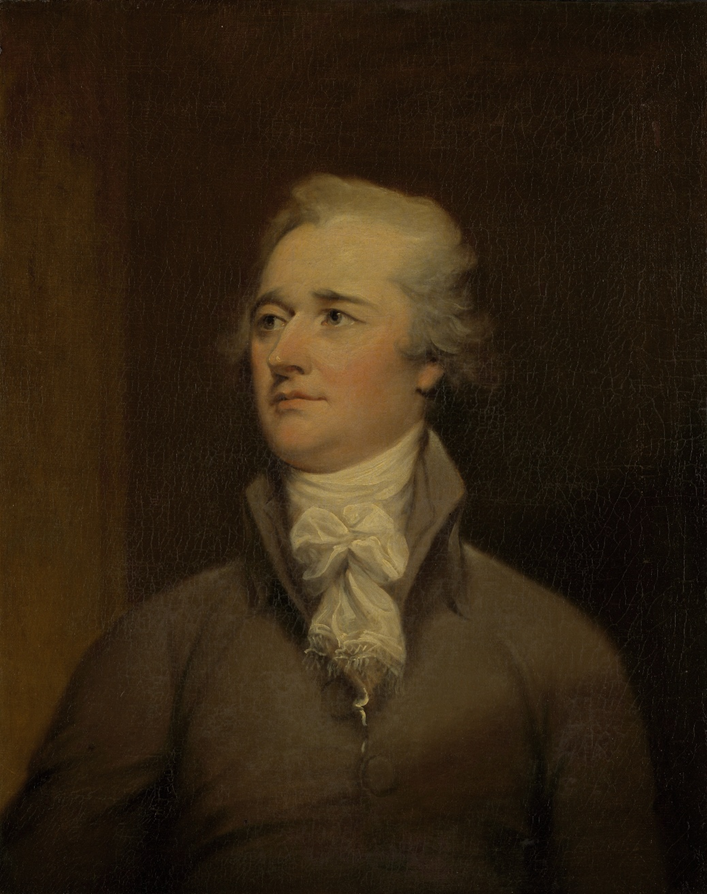
JOHN TRUMBULL. ALEXANDER HAMILTON. 1792. PHILADELPHIA, PENNSYLVANIA.
Another notable character in the painting is Trumbull’s own older brother, Jonathon Trumbull, Jr. who had served as Secretary to General George Washington from 1775-1776. Trumbull’s brother is easy to pick out because there is such a strong family resemblence between the two. Many people see the figure’s likeness and assume that it is John Trumbull himself that he insterted in the painting, but this is incorrect. You can find Trumbull’s older brother fifth from the left. Finally, it always appears to me that the two horses by Trumbull’s brother are whispering amonst themselves and comparing notes, but maybe that’s just me.