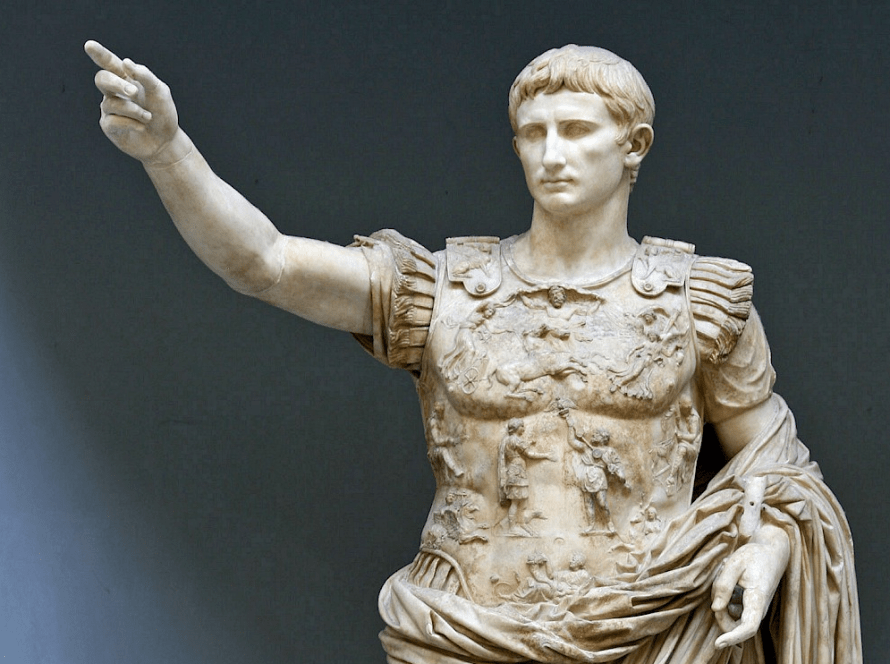
After Harvard and his service in the American Revolution, John Trumbull left America to study under Benjamin West. West was an American painter who had begun life as a portrait painter but had progressed in talent and respect enough to now be the official painter of George III. West was well known for his history paintings and when Trumbull was younger, was exactly the kind of man that he had hoped to apprentice.
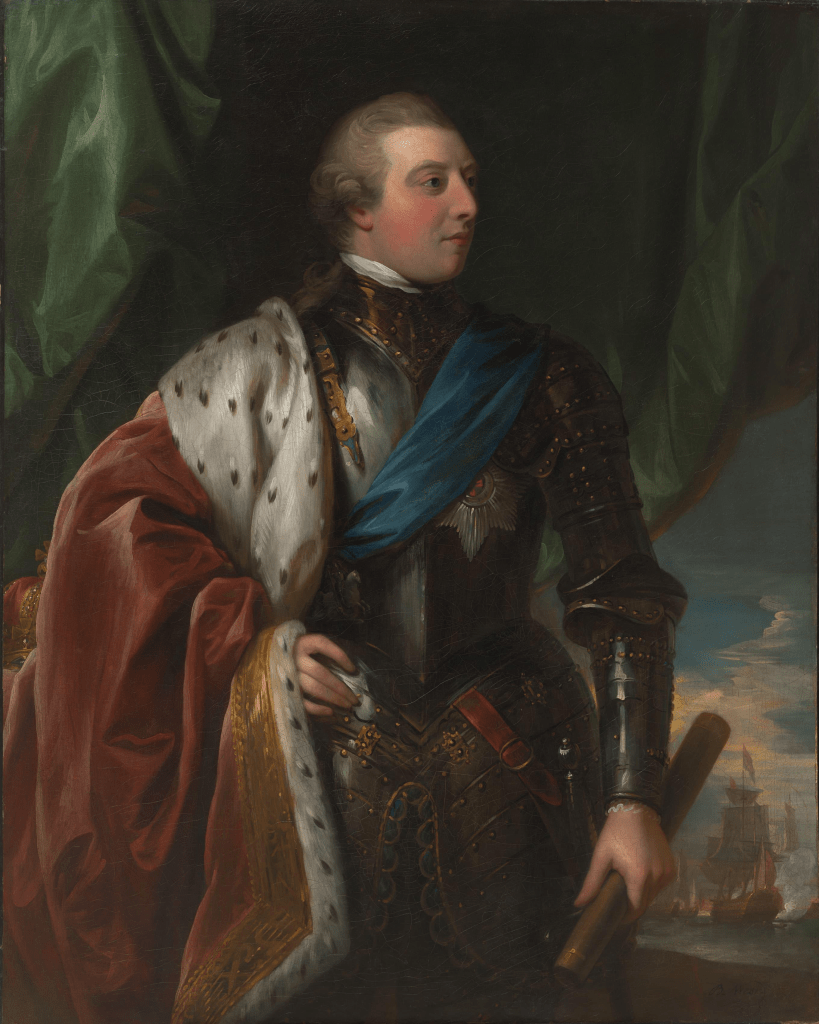
Benjamin West. George III 1761- 1762. London, England.
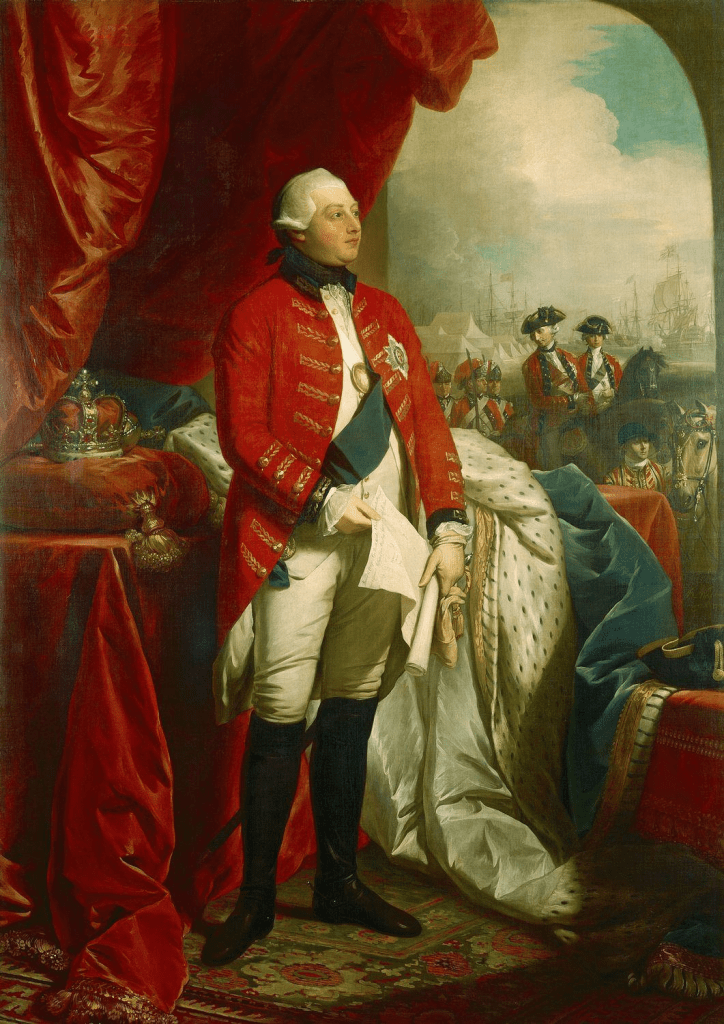
Benjamin West. George III 1779. London, England.
West had a studio in his house on Newman Street in London where Stuart often worked as his assistant. As was often the case in artist training at the time, Trumbull worked under West, and often with Stuart, finishing details in paintings commissioned. There is a story about when Stuart and Trumbull just met. Trumbull brought a picture to Stuart for some evaluation. Stuart, after studying the picture, remarked that he was “…puzzled by the drawing and after turning it this way and that…said…this looks as if it was drawn by a man with one eye…” To this, Trumbull took great offense, because of his childhood eye injury that caused him to lose sight in one eye. In some ways this was a gift because Trumbull’s limited vision caused him to pay incredibly close notice to every small detail.
Besides his large-scale historical paintings, West painted portraits throughout his life. When he was still young, he painted a self-portrait miniature of himself. The dating comes from West, himself, stating, “I was then eighteen years old, it is now sixty years ago.” This isn’t West’s earliest dated work though. Even earlier than this, West painted a series of portraits of Jane and Robert Morris that are dated from 1749-1752 making West between eleven and fourteen years old when these were completed.

BENJAMIN WEST. SELF PORTRAIT MINIATURE. 1758. PHILADELPHIA, PENNSYLVANIA.
Around the age of eighteen, when West painted his miniature, he lived in Philadelphia where he worked as a professional portraitist. From this period, there is a sketchbook that includes rough portraits of at least sixty people presumably for later portraits, including West’s father. While in Philadelphia working on portraits, he could charge two- and one-half guineas for a head portrait and five for a portrait to the waist. For a time, after Philadelphia, he would live in New York making portraiture and could charge twice this amount. While in New York, West painted a portrait of a man who paid the ten guineas and then paid an extra fifty guineas on top of this as a sort of tip. This was enough money to help West to travel to Rome and study painting in Italy.
Art historians lament the perceived loss of West’s early portraiture. Though painted for private use, now the paintings are of endless fascination for West enthusiasts. Dunlap, author of “History of the Rise and Progress of the Arts of Design in the United States” explains this loss, “In New York he [West] painted many portraits, but few have been preserved from those tombs of the Capulets destined for the works of the mass of the painters- the nursery where urchins set them up as marks for their puny archery; or the garret, where cats litter among the satins of our grandmothers, or mice feast on the well-powdered wigs of our grandsires.” Dunlap’s point that private portraiture is often lost to floods, fire, and other catastrophic incidents is well taken. Private portraits live in a more precarious state than portraiture meant for the public. Dunlap could have also overlooked the fact that New York, before the Revolution, was smaller than Philadelphia and did not have a cultural climate to support many portraitists.
What market there was in New York was taken by John Wollaston. It is possible that the reason that West did not have as much portraiture while in New York as compared to his residence in Philadelphia could have been simply that he was still young. Wollaston, an established English painter, would have seemed to be a choice of portraitist at the time. Wollaston can be seen as an early influence on some of West’s early portraiture in the way he handles the eyes. West’s portrait of Elizabeth Peel is very similar to Wollaston’s portrait of Margaret Oswald, even down to the obvious left eye slant present in both paintings.
There is a portrait of West that was painted by Copley in 1776-1780. It was not unusual for artists to paint one another. It was a compliment to the artist portrayed and was good advertising for the artist painting the portrait. West looks elegant in his wig and red coat. He stands to the side, looking back at the viewer. The background is dark but over his shoulder, there is a window with an open vista showing clouds and trees. Copley and West were both living in London at the time of this portrait. This portrait would have been considered both for the private and public domain when it was painted. A well-known artist painting another well-known artist would have garnered attention. Another sphere can be added to the audience of this portrait, that of artists. This portrait was a public statement of approval from Copley to West and all the other artists at the time understood the compliment.

JOHN SINGLETON COPLEY. BENJAMIN WEST. 1776-1780.LONDON, ENGLAND.
McLanathan, Richard BK. “Gilbert Stuart.” (No Title) (1986).
Sizer, Theodore. “The Autobiography of Colonel John Trumbull, Patriot-Artist.”
Sawitzky, William, and Benjamin West. “The American Work of Benjamin West.”