When the commission of the paintings for the Capitol Rotunda was being discussed, Trumbull was desperate to be chosen. This seemed to him to be the culmination of what he had worked for all his life. To this, he swallowed his pride and wrote to Jefferson asking for his endorsement. Jefferson, remembering their earlier days of friendship wrote to then President- elect James Monroe on behalf of Trumbull. Jefferson also wrote to the Senate praising Trumbull for the commission saying that Trumbull was “superior to any history painter of the time except [Jaques- Louis] David” and that it was “extremely desirable” that Trumbull be chosen. There were objections of Trumbull’s age, saying that he was “a man of a generation,” criticism of the large size of the paintings and anger over the exorbitant price tag, $32,000 for all four. Eventually, though, Trumbull would overcome all objections, and the commission would be his.
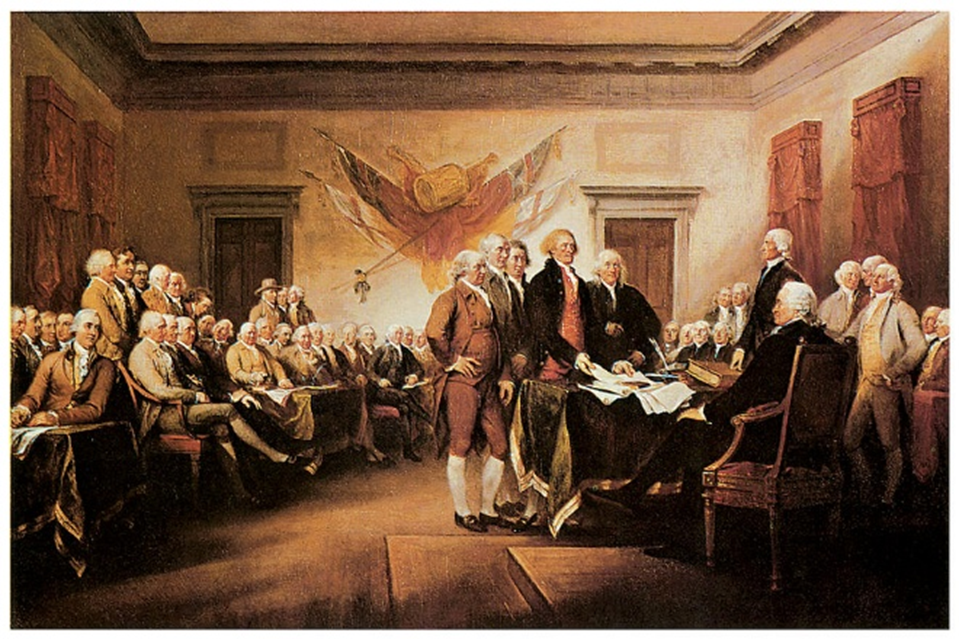
The first painting for the Capitol Rotunda was “The Declaration of Independence” and is considered by many to be Trumbull’s most famous painting. This larger-than-life work graces both the Capitol Rotunda and the back of the increasingly rarer two-dollar bill. The image has even been used for postage stamps from time to time throughout American history. “The Declaration of Independence” is a comprehensive depiction of early America. First painted in 1786, this painting was first quite small, a modest 21” by 31.” This painting was not without criticism, however. While it is often said to be “The Signing of the Declaration of Independence” this painting does not depict the actual signing but instead the presentation of the document to Congress. The general perception is that this painting depicts the signers all gathered in a room at the same time. This is the wrong idea and gives an incorrect impression because this was a rough and dangerous time in American history. Instead, signers probably came as they were able when it was deemed safe to put their name to paper. Trumbull, aware of the misconstruction that people were making when viewing the painting, explained that he had exercised artistic license when putting the scene together.
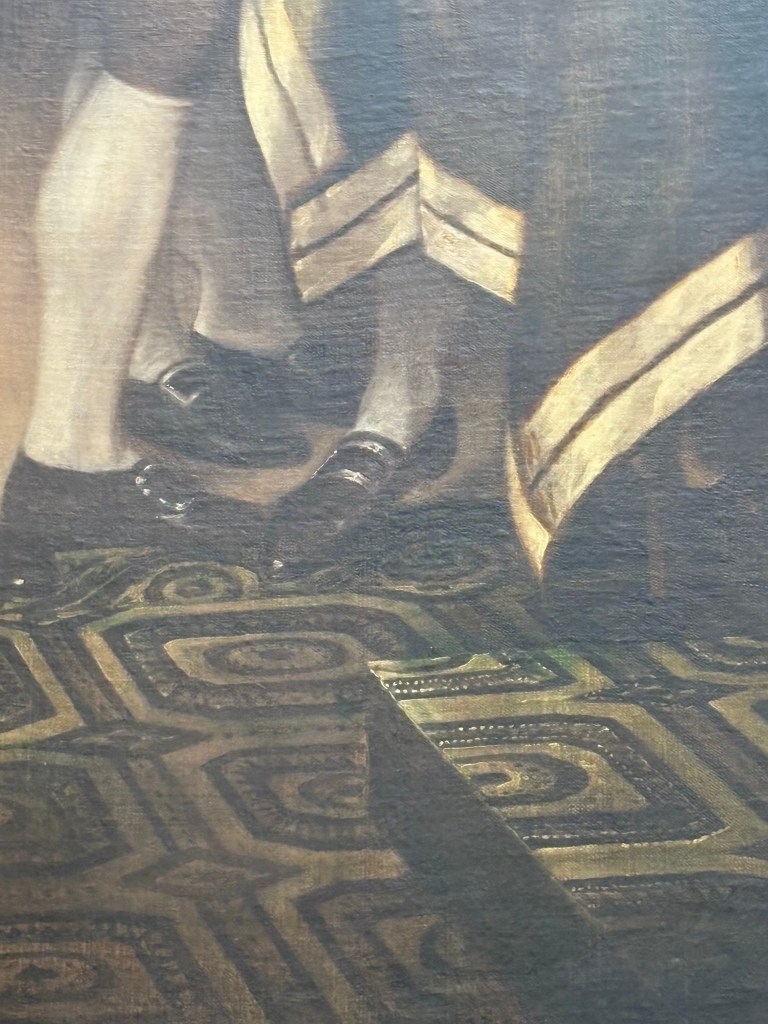
In all other ways, Trumbull was meticulous with details. To make each person as close to life as possible, Trumbull visited each of them, even if it meant traveling. He would study previous portraits made and since two of the men had died, Trumbull then would use a relative, like a son, to make sure the likeness and expressions were as close as possible. There is one more noteworthy item about this painting. There was a rumored friendly rivalry between Thomas Jefferson and John Adams. It appears that Jefferson is stepping on Adams’ shoe in the painting, but that is just an optical illusion. In later versions of the painting, their feet are just placed close together.
Staiti, Paul. Of Arms and Artists: The American Revolution through Painters’ Eyes.
Cooper, Helen A., editor. John Trumbull: The Hand and Spirit of a Painter.
Hazleton, John H. “The Historical Value of Trumbull’s” Declaration of Independence”.” The Pennsylvania Magazine of History and Biography 31.1 (1907): 30-42.
Greenberg, Ivan. “Postage and Power: US Nationalism and the 1970s “Bicentennial” and “Americana” Stamp Series.” Journal of Social History 49.1 (2015): 53-76.
Brookhiser, Richard. Glorious Lessons: John Trumbull, Painter of the American Revolution.
Declaration Resources Project. “Unsullied by Falsehood: No John Trumbull.” Declaration Resources Project, Harvard University, 4 July 2017, https://declaration.fas.harvard.edu/blog/trumbull.