It is easy to forget that even though much of Roman art has lost its luster and color over the centuries, in the beginning, Romans loved vibrant painting. Romans would paint murals on walls for decoration and to show affiliation with politics, religion or wealth. These paintings could be found in public and private buildings but most have been lost to history. However, in Pompeii, many paintings have been preserved in the ashes. There are four main styles of Roman wall painting that have been discovered in the ruins of Pompeii. Each of these styles is useful in dating the buildings that they have been found in. This is because each of the murals contain enough details and elements that are different from one another that a researcher can easily distinguish which style they are looking at. While each of these four types of paintings are based on illusions, they are all different. These separate painting styles reflect what was important to Romans at the time of the decoration.
The first style of Roman wall painting can be recognized by its dedication to displaying walls that appear to be of cut stone or of other construction materials. These walls were meant to look like marble, onyx or other expensive stones so that they appear structural. Sometimes this style is known as Masonry. These walls are separated into three sections. The first section is called a socle. This is a flat panel surface that serves as a base for the second section. The second section is the most ornate. It is generally blocks painted with recesses on the edges to give the effect of masonry. The top section would be completed with dentil cornices, entablature or even colonnades. This is all very ornate, but it is basically a wall painted to look like blocks of something expensive, when this is only plaster. Below is an example of the first style from the House of Sallust in Pompeii.

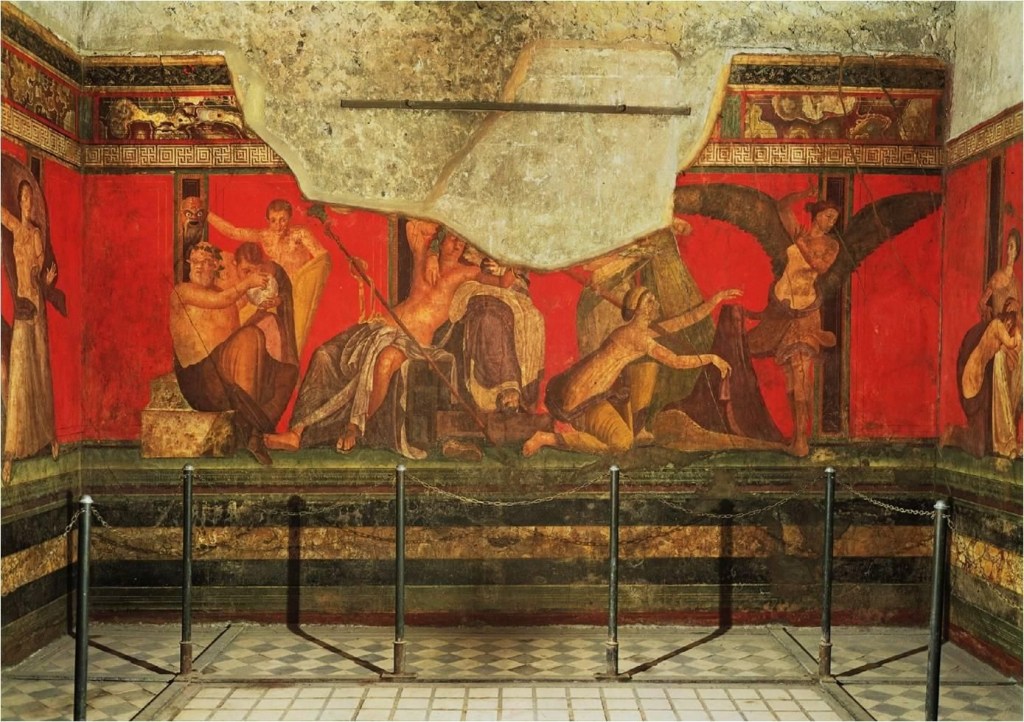
The second style of wall painting that Romans embraced was a way to make a solid wall appear as if it was a sort of open wall to somewhere else completely. This is also known as the Architectural style. Here, there are panels painted, but now included are framed scenes that range from mythological scenes to landscapes to classical Hellenistic scenes of life. There are now painted ledges, windows and other items to trick the eye into seeing an effect that is not actually there. This all represents a shift in thinking. Romans have now drifted away from just painting a wall for decoration to creating a mood with imagery to enhance their homes and public spaces. A good example of the second style of painting can be found atPompeii’s Villa of the Mysteries.
The third style of Roman painting veered away from the ornate images of the second style and embraced a much more elegant refined set of imagery. Now, the walls would be panels of color, saving the decorative pieces for the top section of the walls. Stylized images such as columns or candelabras would be painted in such a way to show decoration, as opposed to actual pictorial scenes of landscapes. There are still scenes painted in panels in this style but Romans are no longer trying to convince the viewer that these scenes are vistas to the outside world. Instead, the scenes are viewed as in pictures on the wall. In a way, the focus has come back to the room, instead of trying to make the room something it is not. An example of this style of painting can be found at the house of Marcus.

The fourth and final style of Roman art painting encompasses elements of some of the previous styles. For example, landscapes have come back into fashion in the middle section of the wall, but now there are other elements, as well. Cupids are sometimes depicted floating about the panels (Lorenz 14). There are now decorative borders to the panels that can be very ornate. Sometimes these borders include small vignettes. It is as if the third style had become not elaborate enough, so the Romans enhanced it and brought back previous decorative elements to make it even better. Below is an example of the fourth style of Roman painting from the House of Vetti.

Reference
Lorenz, Katharina. “Wall painting.” A companion to Roman art (2015): Ch.13.