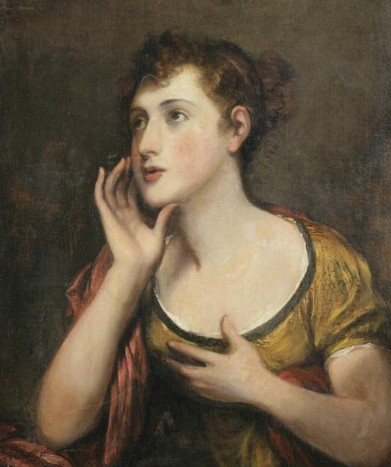
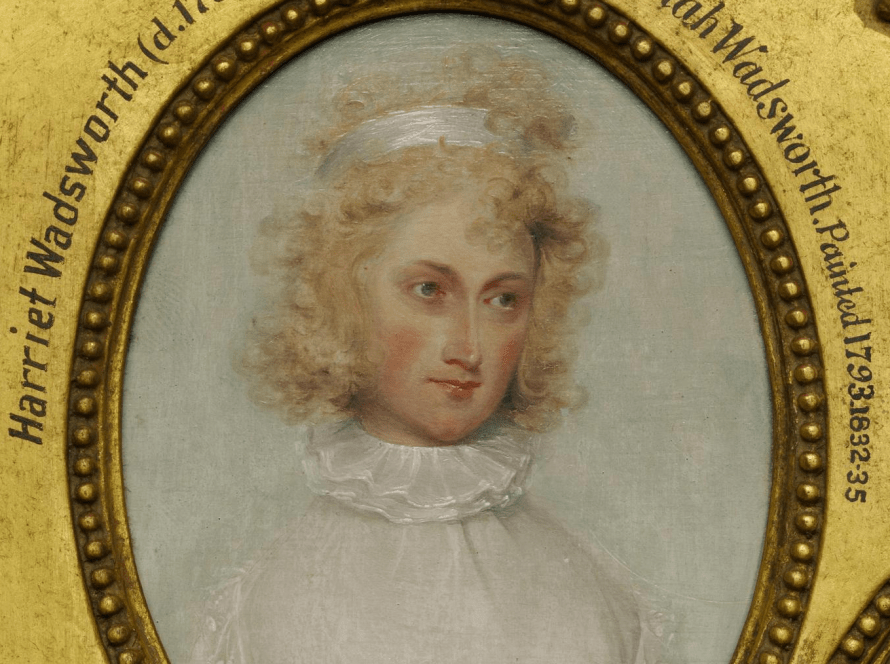
Through his portraits of Sarah Hope Harvey Trumbull, Col. John Trumbull advanced beyond his monumental history paintings to explore intimacy and early American identity that revealed how their personal relationship shaped a softer, more private dimension of Trumbull and early American portraiture. Though often overshadowed by her husband’s fame as the “Painter of the American Revolution,” Harvey played a critical but predominately overlooked role in shaping Col. John Trumbull’s later life and legacy, offering emotional stability, managing domestic affairs, and quietly influencing his artistic ambitions. Her quiet influence highlighted the oftentimes unseen impact of women in early American history. Harvey would follow Trumbull wherever and however life would lead them. Throughout their marriage, the Trumbull family faced economic uncertainty as commissions would experience cycles of prosperity and hardship, but she was a steadfast partner for Trumbull. Things would change for the better when Trumbull was selected for the commission for the under-construction Capitol Rotunda. This crowning achievement meant that Trumbull, with Harvey, had arrived professionally and publicly.
Historian Theodore Sizer wrote that Trumbull had four main threads that ran throughout his life. The first thread was that he considered himself and conducted himself as someone exceedingly well-born. Trumbull owned his lineage as American aristocracy proudly. Trumbull’s father had been both a Colonial and a Revolutionary Governor for the State of Connecticut. Trumbull had a sense of pride of place and self that was evident. The second thread running through Trumbull’s life was the loss of vision in his left eye when he was a child. Although, in some ways this made him a better painter because he was more scrupulous with details, in other ways, he was constrained. For example, Trumbull preferred to paint smaller pieces, instead of the large paintings in the Capitol Rotunda that he is well known for. Trumbull was also adept at painting miniatures. Large-scale pieces were too easy to get the proportions incorrect because of depth perception. He had to work hard to overcome this. Trumbull’s life was his sharp intelligence was the third main component in his life. He was well-educated, graduating from Harvard at the age of 17. He was the first American- born painter to be a college graduate. Trumbull was good with foreign languages and learned to speak Greek and French. The final thread was his history as a Revolutionary War officer. He was commissioned as a Colonel in the Continental Army. For a short time, he served under George Washington. Trumbull’s twenty-four-year marriage to a mysterious English woman named Harvey would be the fifth thread that ran throughout his life. The marriage, a surprise to those around them, would mark a turning point in Trumbull’s life from diplomat/painter to a man who was determined to be a successful painter.
Trumbull would claim that his greatest accomplishment was the four historical paintings that hang in the Capitol Rotunda. The Capitol Rotunda, the massive dome-shaped building built in Washington DC between 1818 and 1824, has often been described as the symbolic and physical heart of our nation’s capital. Inside the large dome that connects the House of Representatives and the United States Senate are a series of eight paintings. Trumbull is responsible for four of these paintings.
Commissioned in 1817, these larger-than-life historical paintings measure twelve by eighteen feet. Trumbull would paint the “Declaration of Independence” first, followed by “Surrender of Lord Burgoyne,” “Surrender of Lord Cornwallis,” and finally “George Washington Resigning his Post.” These four paintings were timely providence for Trumbull because with the commission he was able to make right the finances that they had suffered while living in England and also to achieve that status of history painter that he had so long craved.
Originally, it was believed that Trumbull would complete all eight paintings, but at some point, it was decided to open the rotunda to other artists, a slight that Trumbull with his formal demeanor would remain resentful. His four paintings that grace the rotunda tell the story of our nation’s quest for independence. Through larger-than-life renderings of earlier works that Trumbull had completed during and just after the American Revolution, Americans today can still feel the experience of our most important historical events.
One of Trumbull’s most significant moments in his life was the short time that he served as aide-de-camp for Washington. Later, he earned the commission of Colonel but through administrative errors with dates, he was awarded his commission late. Trumbull resigned furious and resentful. Proud by nature, he continued to refer to himself as Colonel for the rest of his life, even after the disagreement with his commission.
Trumbull and Harvey married in October of 1800. He was quite a bit older than his new wife. She was twenty-six and he was forty-four years old. Their union was unexpected and there are stories that she never assimilated with his family and social class. Trumbull, from one of the most prominent families in Colonial America chose an English woman with no money and no social connections to recommend her. They never had any children, although Trumbull did have an illegitimate child, John Ray, before he and Harvey met. Trumbull had a tryst with a servant in his brother’s household, who later had a child. This would become a constant humiliation and complication for Trumbull for the rest of his life.
Harvey seems to be a calming influence on Trumbull. She inspired him to resume painting after taking a break as a diplomat. She encouraged his relationship with his child, which he had neglected. She traveled with Trumbull and moved with him several times back and forth across the Atlantic Ocean, from England to America and then back and forth again.

Early twentieth- century historians seem to discount the portions of their life together that indicate a pleasant union and to emphasize any items that do not reflect well on their marriage and Harvey, in particular. There was a letter from Trumbull’s friend Rufus King to Christopher Gore which details a party where she indulged in too much alcohol and disrupted the occasion. He detailed that she was difficult to handle, embarrassing, and generally inappropriate, but this letter is not the complete story of Harvey. Trumbull never entertained the negative narrative about his wife from others. Instead, there is a lengthy letter written to his own family criticizing them for not welcoming Harvey as his wife should be welcomed. Trumbull presented the couple as a united front to his friends and family, no matter how poorly she was received. Instead, Trumbull has written repeatedly that Harvey was a devoted and loving spouse and his own best friend.
Harvey would act as a muse for Trumbull throughout their marriage. He painted her portraits; he sketched her privately. He painted her in religious and historical scenes. He painted her on her deathbed. On the day of his death, in his bedroom, in places of honor, hung two portraits he had painted of her. The portraits that he painted of her now occupy the space between private and public portraiture. What Trumbull meant as a family heirloom is now studied to understand Trumbull, his painting, and their lives together, but that was not his original intention.
This is a common issue with portraiture. One family’s keepsake, in the next generations, is a history lesson. By comparing Trumbull’s paintings of Harvey to works of other artists such as John Wollaston, John Singleton Copley, Benjamin West, Sir Joshua Reynolds, Gilbert Stuart, and Charles Wilson Peale, portraiture from the late eighteenth century and early nineteenth century can be examined for similarities. The portraits can be analyzed for how portraiture was originally intended for private use then in time became part of the public domain as a historical cultural artifact. These portraits are used today as a visual biography, where the viewer interprets the past through the culture of today. Trumbull extended beyond history painting to explore intimacy through portraiture that acts as a record of early American art and his personal life with Harvey, as well.
Brookhiser, Richard. Glorious Lessons: John Trumbull, Painter of the American Revolution.
Sizer, Theodore. “The Autobiography of Colonel John Trumbull, Patriot-Artist.”
[8] Pointon, Marcia. Hanging the Head: Portraiture and Social Formation in Eighteenth-Century England. Yale University Press, 1993.
Staiti, Paul. Of Arms and Artists: The American Revolution through Painters’ Eyes. Bloomsbury Publishing USA, 2016.
Sizer, Theodore. “John Trumbull,” Patriot-Painter,” in Northern New York.” New York History 31.3 (1950)
Cooper, Helen A., editor. John Trumbull: The Hand and Spirit of a Painter. Yale University Art Gallery, distributed by Yale University Press, 1982.
Staiti, Paul. Of Arms and Artists: The American Revolution through Painters’ Eyes. Bloomsbury Publishing USA, 2016. Pg. 279.
Sizer, Theodore. “John Trumbull,” Patriot-Painter,” in Northern New York.” New York History 31.3 (1950): 283-293. Pg.2.[
Cooper, Helen A., editor. John Trumbull: The Hand and Spirit of a Painter. Yale University Art Gallery, distributed by Yale University Press, 1982. Pg. 125.