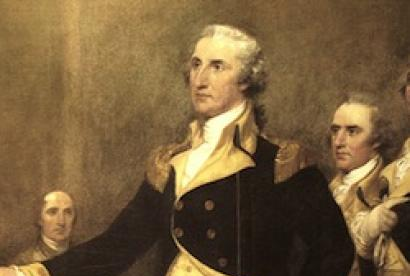
Early American artists often traveled from city to city to study and to paint the portraits of notable members of society and the wealthy elite. Many times, these artists also had higher aspirations of becoming history painters, but always they had to earn a living. Portrait commissions were the most reliable way for an artist in early American society to earn an income. You could charge by the sitter, by the pose and by the relative success and reputation that each painter enjoyed. Even the cities played a role in portraiture, as a city like New York or Philadelphia would likely have more high- dollar commissions than a smaller city.
Early American portraiture is a singular art form because it often is difficult to discern the public audience from the private audience. Today, when admiring one of Trumbull’s portraits of Harvey, especially the last portrait “Sarah Trumbull on her Deathbed” the viewer is gazing at a painting that in Trumbull’s lifetime was private. This painting was so personal to him that he kept it covered with a silk curtain, and hung it over his bed. Now, this portrait is housed at the Yale University Art Gallery which is a significant shift from Trumbull’s early private ownership.

JOHN TRUMBULL, SARAH TRUMBULL ON HER DEATHBED, 1824, UNITED STATES.
Even commissioned portraits are generally private; in that they are most often meant for the family to be handed down. These portraits become more public as time passes because they reside in a museum and are used as historical markers. Other times, the sitter has become notable in some way and so over time, their portraits become more and more desirable. Either way, what once was meant as private has evolved into the public sphere. It was in this atmosphere of early American portraiture that Trumbull was born.

. JOHN TRUMBULL, GOVERNOR JOHN AND FAITH ROBINSON TRUMBULL PORTRAIT, 1783, UNITED STATES.
As a baby, Trumbull suffered convulsions. Through the rigorous intervention of his mother, he was cured. Trumbull records that he was like a completely new person. He was an eager student. Trumbull wondered if his brain, after such an illness, had been set free. He found that other languages came easily to him, learning Greek by the age of six. More importantly, he found a spark of creativity that he did not know existed before. In his autobiography, Trumbull records himself as a frail child who could not compete easily with the outside pursuits of boys his age. He stayed inside much of the time. Trumbull writes:
“My bodily health was frail, for the sufferings of early youth had left their impress on my constitution, and although my mind was clear, and the body active, it was never strong. I therefore seldom joined my little schoolfellows in plays or exercises of an athletic kind, for I was almost sure to be vanquished, and by degrees acquired a new fondness for drawing, in which I stood unrivaled.”
One day while playing with his sisters, frolicking he called it, Trumbull fell down the stairs. This incident is said to have caused an injury that resulted in Trumbull losing sight in one of his eyes. Several years later, he discovered that he could no longer see out of that eye. In fact, Trumbull said that if he were to only try to use his injured eye, he could not even see well enough to read. Trumbull’s vision would be a constant source of trouble for him with his injured eye and the other eye weakened by strain. This did not hamper his creativity, however. Instead, it gave him a determination to have a more scrupulous eye for details.
Young Trumbull would copy his sister’s needlework by copying their handiwork, drawing right on the freshly sanded floors of their family home. His time indoors led to more and more time drawing which made him unrivaled among his peers. He describes a shy, embarrassed, awkward boy who by degrees began to love solitude, which led to drawing, which led to solitude and on and on. This was the birth of his artistic career.
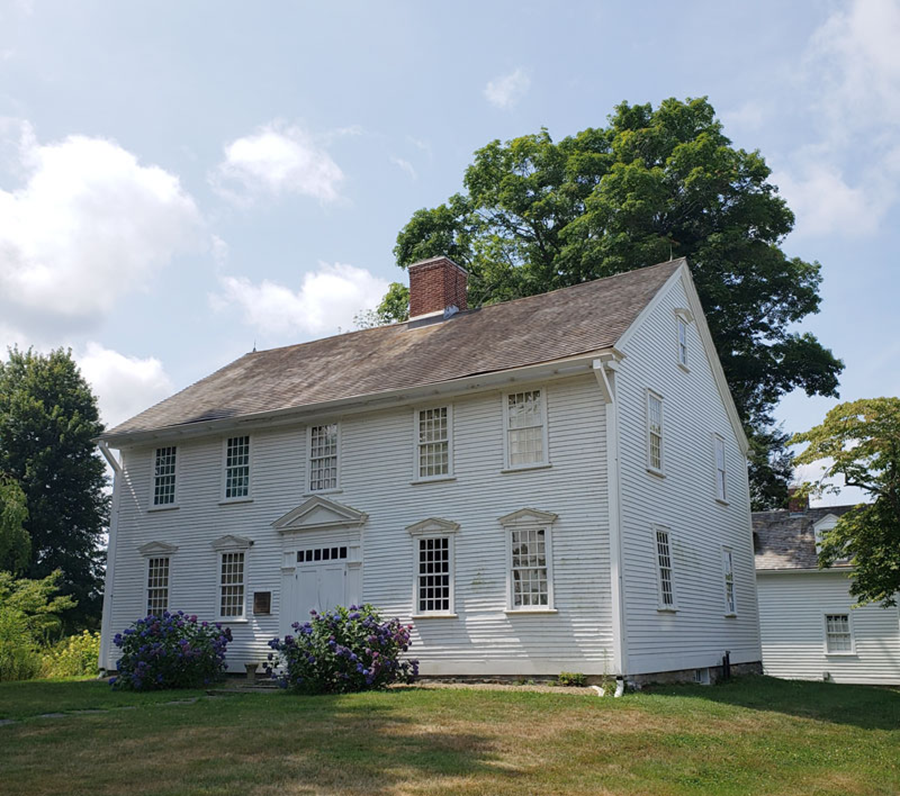
GOVERNOR JOHN AND FAITH TRUMBULL FAMILY HOME, 1740, LEBANON, CONNECTICUT.
[1] Brookhiser, Richard. Glorious Lessons: John Trumbull, Painter of the American Revolution.
[5] Boettcher, Graham C. “The Artist’s Queen: John Trumbull’s” Sarah Trumbull on Her Deathbed”. Yale University Art Gallery Bulletin (2015).
[6] Sizer, Theodore. “The Autobiography of Colonel John Trumbull, Patriot-Artist.”