Part I- Technical Analysis
- Sarcophagus created for Roman Military Commander- Funerary Art.
- Artist- Unknown Roman
- Date 140 AD- 170 AD (MFAH, 2023)
- Medium- Warm Cream Marble
- Dimensions- 40 1/2 × 91 1/2 × 50 1/2 in., 5511.5lb. (102.9 × 232.4 × 128.3 cm, 2500kg)
- Provenance- Private collection, Eastern Europe, 19th century; purchased by Pierre Sciclounoff, Geneva, 1960s–late-1980s; private collection, mid-1990s; [Phoenix Ancient Art, New York/Geneva, by at least 2003–2006]; purchased by MFAH, 2006. Museum of Fine Arts Houston purchase funded by the Agnes Cullen Arnold Endowment Fund in memory of Peter C. Marzio (MFAH, 2023).
- Location- Audrey Jones Beck Building, Main Lobby, Museum of Fine Arts Houston (MFAH, 2023).
- Brief Description- Sarcophagus three dimensional box for burial of a human, composed of a warm cream marble. This sarcophagus is highly decorated and likely the burial place of a high ranking Roman military officer. A battle scene is depicted on the sarcophagus of what could be Roman soldiers, but could also be Greek soldiers from mythological antiquity, conquering the Amazons, a legendary group of women known for their military prowess. The battle scenes are repeated motifs surrounding the tomb. It goes from one large soldier battling two Amazons on horseback, one with an ax the other with a spear. The Amazon woman on horseback with the ax has a cape flying in the wind behind her, giving the scene a feeling of motion. There is a woman lying on the ground with one of her breasts exposed under the horse of the Amazon woman with a spear. On each long corner, there is a large guard-like soldier who has a captive Amazon woman on her knees with her hands presumably tied behind her back. This battle scene even repeats exactly on the shorter sides of the tomb. The only difference is that behind the Amazon on horseback with the spear there are different objects. Three times, there is another horse. Once, it is a horn-like instrument. Once, it is two round cylinders, maybe a quiver? Finally, once it is a round disc of some sort, maybe a shield?
Part II- In Depth Description
- Lid-This box has a full lid that covers the entirety of the sarcophagus. Beginning with the lid, it is fashioned like a roof for the sarcophagus. The roof resembles that of a Roman Temple. There is a cornice that surrounds the lid, with six pediments, two on the longer sides, and one on each shorter side. The raking cornice displays embellishments, with ribbon scroll-like detail culminating on the sides and top of the cornice with large shell-like details. In the entablature area of the Roman roof of the lid of the sarcophagus, there is a round medallion embellishment present on both of the shorter sides of the lid. Along the longer sides of the lid, at the edge of what would be the roof tiles for the Roman roof depicted, there are lion’s heads. There are five lion’s heads on each side, making for ten lion’s heads in total. The lions are depicted with their mouths open, showing their teeth, and sporting full manes.
- Base- The base of the tomb is made up of several rows of decorative trim. The first row, nearest the bottom, is plain. This gives the sarcophagus a clean but substantial base to begin. The second row is a row of trim that resembles twisted rope. The third row is very embellished with decoration that resembles harps in a row. The fourth row is a series of geometric shapes. The fifth row is the widest yet, and is a zig zag pattern . The final row, that is just below the relief panels of the battle scenes, is very decorative with repeating shapes and motifs.
- First Side- This side is a shorter side and consists of one soldier that is larger than life near the corner. This soldier has damage to his knee. He is battling two Amazon women that are each on horseback. One Amazon warrior is missing her head and part of their shield through damage to the tomb. Near the left on the bottom, there is a horse that has some damage to its legs and face. There is also a trampled Amazon warrior underneath the horse of the Amazon woman who is missing their head.

- Second Side- The second side is one of the longer sides of the tomb. This is another battle scene. There are four Amazon warriors on horseback. There are two soldiers, larger than life. There are two women laying on the ground, trampled under the horse of the Amazon with the spear. There is also an Amazon captive woman on her knees with her hands tied behind her back on each corner. There is also damage to this panel where another Amazon woman has lost her head and two different Amazon shields are broken through damage.

- Third Side- This is the other short side of the tomb. There is little damage to this side compared with the other sides. The only visible damage is to one of the Amazon’s lower legs. This side shows one large soldier battling two Amazon women on horses. There is a third horse behind one of the women. One woman holds an ax, while the other woman holds a spear. There is a woman lying on the ground underneath a horse of one of the Amazon women.
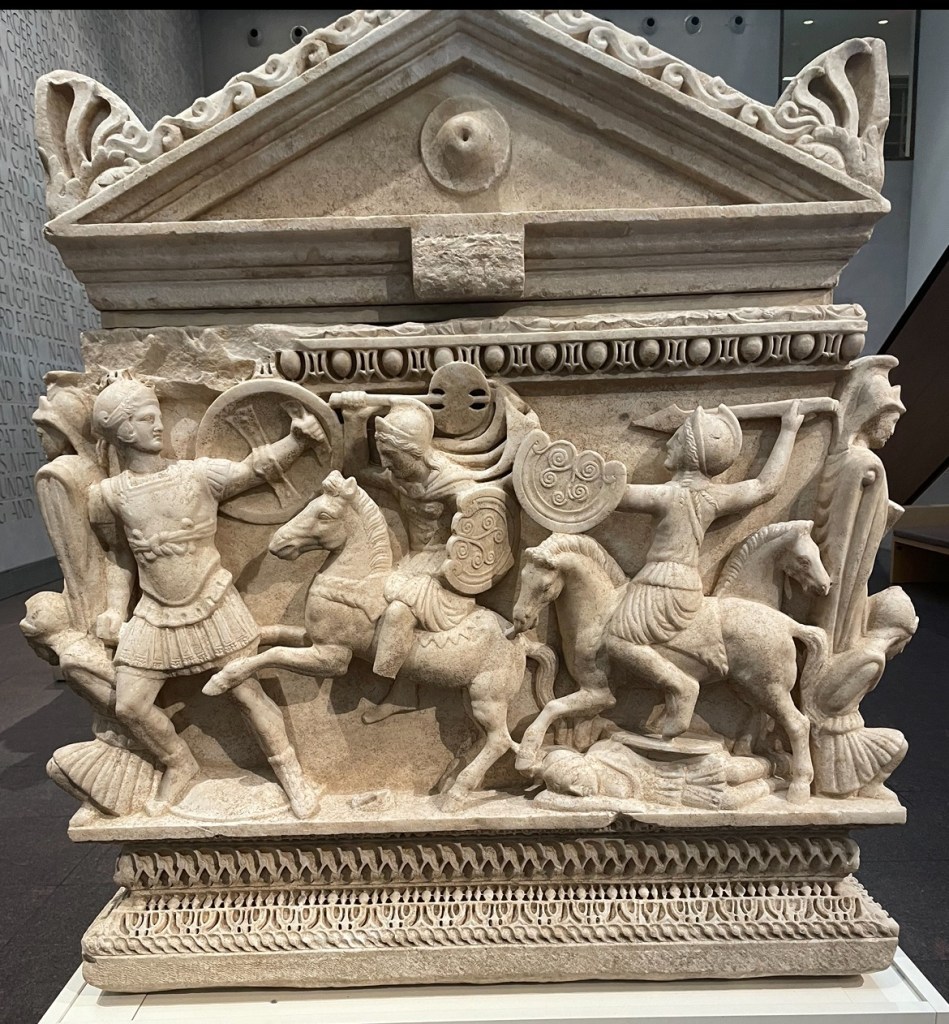
- Fourth side- This is a longer side of the tomb. This shows the two guard-like soldiers with two Amazon women captive on their knees, one on either corner of the side of the tomb. There are two large soldiers, each battling two Amazon women on horses. One soldier has lost his head through damage and one horse has lost its head through damage. Two of the Amazon women show damage to their legs while on horseback. There are two women laying on the ground under horses.

Art Elements
- Line- This sarcophagus emphasizes straight lines in its overall shape. It reads like a Roman Temple. The relief panels on each side come off of the box several inches.
- Shape- There is a strong rectangular shape, with a strong triangular roof shape on the lid.
- Light and Value- There is light and shadow play on this sarcophagus because of the battle scenes on the sides of the box. There is such depth created from the figures that there can be deep shadows in the recesses.
- Color- the entire sarcophagus is made from a warm cream marble.
- Texture and Pattern- The battle scene is not in a particular pattern but there is an undulating sort of rhythm to how the battle is depicted, first high, then low, then high again.
- Space- The battle scenes are depicted in a linear fashion, not overlapping, and surrounding the entire sarcophagus.
- Time and Motion- The relief panels give the sarcophagus a feeling of action in motion. The battle feels as if it is taking place presently when you walk around the sarcophagus.
Principles of Design
- Unity and variety. Each panel of the sarcophagus is not unique. There are repeating scenes and repeating motifs of victory and conquering the Amazon women.
- Balance- Although there is asymmetry in the relief panels, the overall appearance of the sarcophagus is symmetrical. This is because the panels are set in such a way that when looking at the whole piece at once, it resembles a Roman Temple.
- Emphasis and Subordination- The emphasis on this piece are the Battle scenes. They feel active and in depth.
- Scale and proportion- The soldiers depicted in the relief panels are larger than life compared to the Amazon women. This is not simply that men are generally larger than women, instead this is a statement of the importance and domination of the Roman soldiers.
- Mass and Volume- This piece is likely very heavy and it appears so. This sarcophagus looks large and important by design.
- Function and setting- This is a funerary object that has been embellished. It is not known where this sarcophagus was originally found or who the military officer was that this box was made for.
- Reference
- MFAH. “Sarcophagus depicting a battle between soldiers and Amazons (warrior women).” Museum Fine Arts Houston. 2023.
- Sarcophagus Depicting a Battle between Soldiers and Amazons (Warrior Women) | Search sarcophagus (Objects) | Search | The MFAH Collections