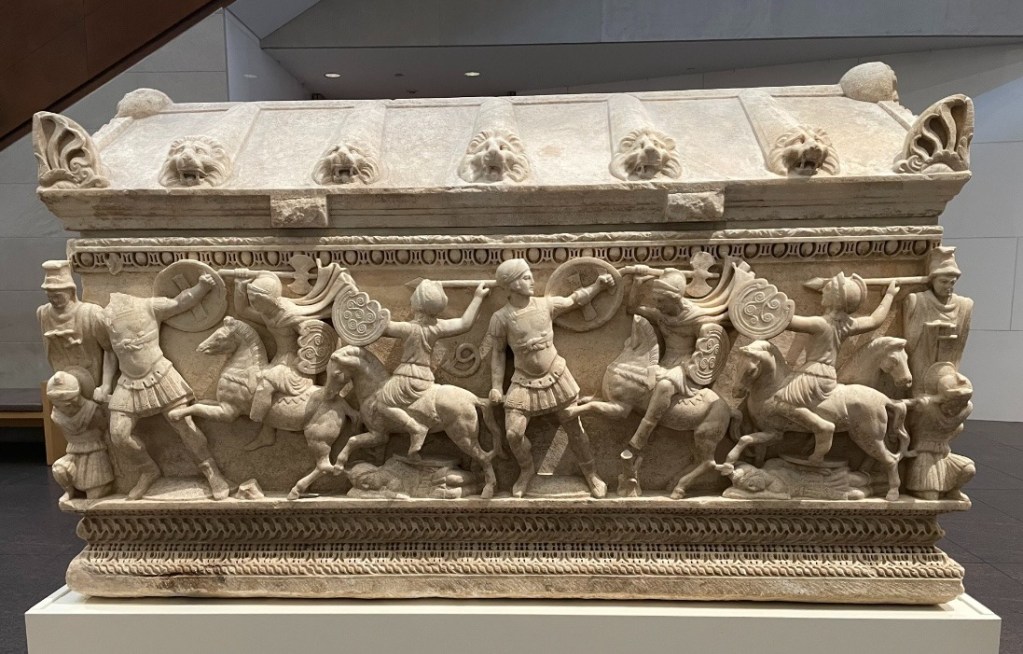
Although the exact date of creation for this sarcophagus is unknown, experts believe that it was made in the second century in Rome. This tomb falls under the category of “mythological sarcophagi” which means that the relief panels are taken from mythology instead of biographical information. This was a common theme among sarcophagi during the second century Rome. The mythology imbues the tomb owner with the same sort of larger than life attributes as the same figures depicted on the sarcophagus. These tombs did not symbolize any sort of vision of the afterlife. Instead, they used symbols, like military victories or ships sailing into harbors to symbolize a life well lived and now completed.
There was a lot going on at this time to influence the decoration of this tomb. Starting around 140 AD, when this sarcophagus could have been made, the antonine wall was being created. This wall was meant to be a wonderful accomplishment of the Roman people, and a way to increase the success of Hadrian’s wall. The Antonine wall was impressive but not as successful as Hadrian’s wall. First, it was made of turf instead of stone. There were ditches on either side, but this northern wall was constantly being challenged. After about thirty years, Romans decided to fall back on Hadrian’s wall and abandon the Antonine wall. Romans, a little downspirited, could have felt that they needed a victory because of the northern invasions. This could have influenced the creation of this tomb, showing great military victory, when the Romans felt like they really needed one.
This victory came in the shape of Marcus Aurelius, who became emperor in 160 AD, the later part of the timeline when this sarcophagus could have been made. Marcus Aurelius was not only successful on the battlefield, but he was also widely respected for his intellect. This double threat of military might and philosophical force was just what Rome needed. Marcus Aurelius brought Rome some of its luster and bravado back. This is the period that the sarcophagus seems best to fit into, although, an argument can be made that it was made during the Antonine Wall period and features the victorious battle scenes as a measure of fanfare for the departed. However, for the Marcus Aurelius time period, Romans were riding high with victories in the military. The sarcophagus suggests its own military boasting and self glorification. With the soldiers larger than life, it is likely that this would be the time period that this sarcophagus is from.
In early Rome, it was more likely when a person died to be cremated. However, in the second century AD, having a sarcophagus built became a very fashionable way to honor the dead in burial. A sarcophagus is a funerary object meant to house the dead in a coffin-like container. These would have been on display in some sort of mausoleum type of structure. Most of the time, these boxes would have only been decorated on one long side or on the two short sides because that is all that would have been visible to visitors in the mausoleum. This makes the sarcophagus depicting the battle with Amazons special because it has been decorated on all four sides suggesting that it was meant to be viewed in such a way that a visitor could walk all the way around it. This suggests an important burial for an important person. Sometimes, when the deceased was wealthy, even the inside of the sarcophagus was decorated with relief panels. Unfortunately, there is no information about the inside of the Amazonian sarcophagus having any decoration on the inside.

(https://blog.lostartpress.com/2017/03/26/a-well-furnished-roman-sarcophagus/ )
There is an example of a sarcophagus for a wealthy Roman woman from 175 AD- 225 AD, right after the time period of the sarcophagus with Amazons, and it has been elaborately carved with images of the woman, furniture at that time and common architecture. This sarcophagus is named the Simpelveld Sarcophagus and is a beautiful example of how elaborate these funerary objects could be.The provenance for this sarcophagus is incomplete. The first record of ownership is from a private collection in Eastern Europe from the nineteenth century. That means that for sixteen centuries, this sarcophagus’ whereabouts have been a mystery. This is the story for many ancient artifacts. With no verifiable way to trace ownership, there is no easy way to say with any certainty who might have been buried in this sarcophagus and where it was originally housed.
There is debate in the art world over what to do with antiquities that do not have any verifiable history before a certain date, 1970. The conflict is that if museums purchase antiquities that have no history it is likely that they have been looted from some site in the not too distant past. A “grounded” artifact has a known findspot, while an “ungrounded” artifact is unknown and possibly looted. Buying the item rewards the looters and encourages more theft from ancient sites. The flip side to this debate is that regardless of how the item was obtained, the safest place for the art is in a museum. The prudent thing would be to keep the item safe without rewarding the looters, but as of yet there is no good answer for this problem. In the case of the Amazonian sarcophagus, it is likely that it was obtained from some treasure hunter, maybe even several hundred years ago, and has been passed around in private ownership since, possibly in good hands, possibly not. This is most likely why so many Roman sarcophagi have been found in pieces. It is difficult to move them because of their size and weight. Also, it is more profitable to sell ten pieces of a sarcophagus to ten different collectors, than find one collector who could afford to buy the entire piece. That is why this sarcophagus is such a rare and important find, it is complete, and only slightly damaged in the relief panels.
The sarcophagus is covered with relief panels depicting the soldiers, larger than life, conquering the Amazons. This is not the only Roman sarcophagus that has been discovered that portrays soldiers in battle with Amazons and mythology was a common theme among Roman art. The Amazons were a civilization of women, that was possibly based in fact, but most likely a fiction of several different societies of that time. Even today, with movies like Wonder Woman, we are still creating fantasies about the Amazons. Based in mythology, the Amazons are as beautiful as they are skilled warriors. They were expert archers and these women were said to have cut off one breast in order to improve their archery skills. Not everyone subscribes to this idea, however and it appears that all of the women depicted on the tomb retain both of their breasts. This was most likely an artistic choice since the artist would have wanted the women to appear as beautiful as possible.
It is an interesting choice to make the Amazons the conquered people on the tomb. There are many real life examples of conquered people that could have been chosen to decorate this sarcophagus but the Amazon women, legendary but fictional, were chosen to decorate the tomb instead. There are some researchers who believe that the Amazons might have been real and were based on nomadic tribes that did have female warriors who could ride, wield an ax and had superior archery skills. Overtime, these legends grew to the Amazon warriors who were so accomplished and fierce. There were other tombs at this time that showed other mythological scenes instead of more realistic ones. This was a style choice that would have been a way to symbolize something important about the deceased. The women are shown both in active battle and also in conquered positions. This is to show how formidable and even intimidating the Amazons were while also showing how mighty the soldiers are to subdue them. Tied up, on their knees or being trampled by horses, the Amazon women are at the mercy of the soldiers. Creating the soldiers as larger than life also gives a legendary appeal to the sarcophagus. They are depicting that this deceased military person was larger than life and legendary in his own right by these decoration choices.
The tomb is sort of an allegory for how men in second century Rome felt about women. First, women did have some power in ancient Rome, but only the power that was begrudgingly given to them by the men in charge. Women were mainly able to exercise their power in relation to who they were related to, who was her husband, father, son, etc. A woman could not be powerful in Rome without the prerequisite ties to males that was needed for legitimacy. For example, just before the creation date of this sarcophagus, lived the Emperor Claudius. His wife, Agrippina, was the mother of Nero from a previous relationship. Her pathway to power lay in who she was married to and whether she could convince Claudius to name Nero as his successor, even though Nero was not his own blood son. She was successful in her quest, even though Nero eventually had her, his own mother, murdered.
This makes a group like the Amazons incredibly tantalizing for men, for here is a group of women who are equal to men and yet do not need or want them within their society. This was a dangerous idea, while also being somewhat sexually charged. The idea that soldier men could subdue this society of women who do not need men, shows in the men’s minds at least, that women really do need men, and cannot be successful going up against them. This sarcophagus is showing that Roman men are the most powerful men on earth.
In conclusion, the Roman Sarcophagus Depicting a Battle between Soldiers and Amazons is an important piece of funerary art because of its near perfect condition and what it represents. The heavily embellished tomb is a beautiful example of sarcophagus art in second century Rome. Reliefs showing soldiers conquering the Amazon women represents Roman male authority and superiority, giving the impression that the person being buried has all of the the fine qualities of the victorious battle that is portrayed, and thus has had a life well lived.
Leal, Erin W. The Empire’s Muse: Roman Interpretations of the Amazons through Literature and Art. Diss. San Diego State University, 2010.
Microsoft Word – Leal_Erin_Ongoing (sdsu.edu)
Mayor, Adrienne. “Warrior women: the archaeology of Amazons.” Women in Antiquity. Routledge, 2016. 969-985.
Ellison, Suzanne.”A well-furnished Roman sarcophagus.” Lost Art Press. March 26, 2017.
A Well-furnished Roman Sarcophagus – Lost Art Press
Tuck, Steven L. A history of Roman art. John Wiley & Sons, 2021.
MFAH. “Sarcophagus depicting a battle between soldiers and Amazons (warrior women).” Museum Fine Arts Houston. 2023.
Marlowe, Elizabeth. Shaky Ground: Context, Connoisseurship and the History of Roman Art. A&C Black, 2013.