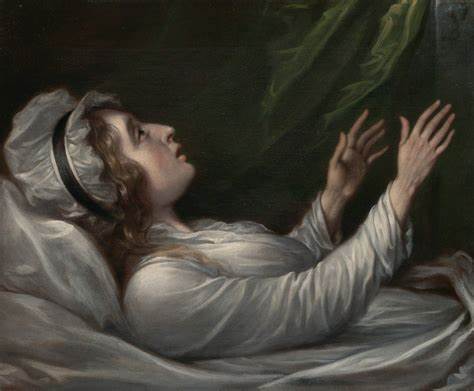
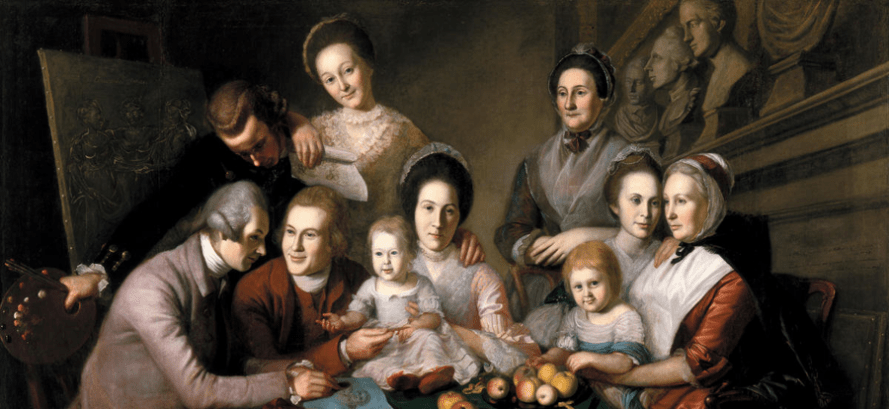
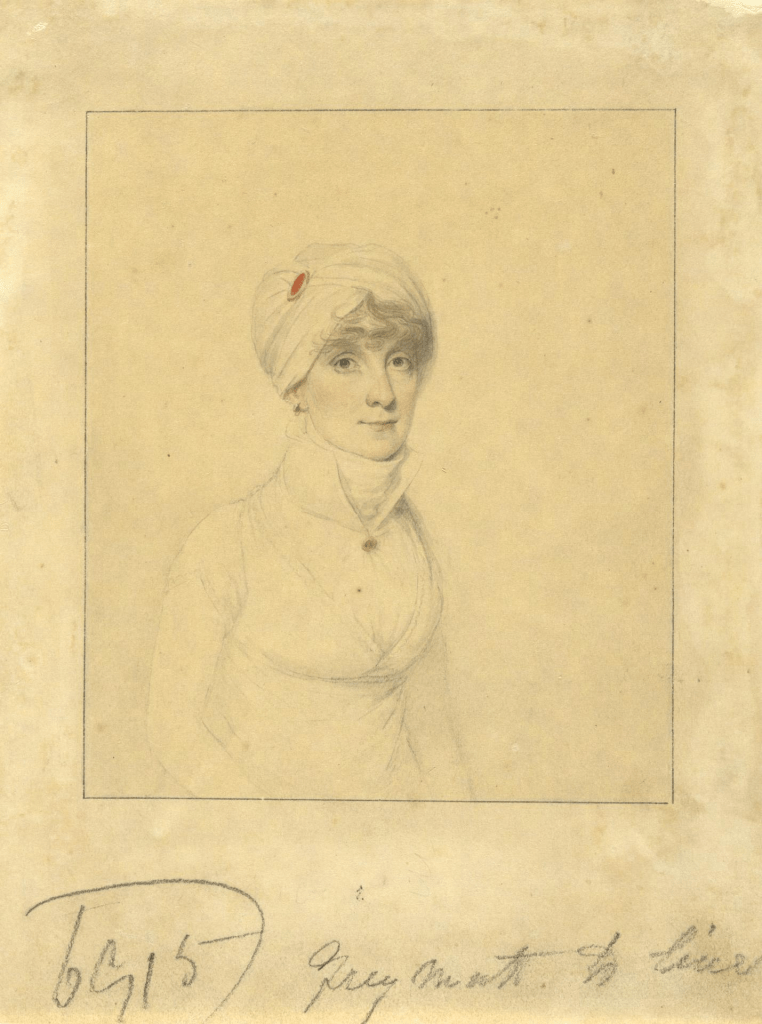
Col. John Trumbull was the fifth child of Gov. Jonathon Trumbull and his wife Faith, pictured above in a print of a painting from 1778 housed as per the Conneticut Historical Society, artist not listed. As it is often with the youngest child of a large family, he had many hours to fill on his own. There is a story of how Trumbull got started on his artistic career. His older sisters were engaged in the education of well to do young ladies of the time, which would have consisted in drawing, painting and embroidery in a girl’s school. Faith, one of Trumbull’s older sisters is pictured below as she was as an adult, artist Elkinah Tisdale. Faith died tragically by suicide after a lengthy depression from horrors witnessed from being present at the Battle of Bunker Hill.
During his childhood, young Trumbull would copy his sister’s needlework by copying their handiwork, drawing right on the freshly sanded floors of their family home. In his autobiography, Trumbull records himself as a frail child who could not compete easily with the outside pursuits of boys his age. His time indoors led to more and more time drawing which made him unrivaled among his peers. He describes a shy, embarrassed, awkward boy who by degrees began to love solitude which led to drawing, which led to solitude and on and on. Additionally, his family at this time had suffered a financial setback, so Trumbull was not sent off to Harvard at the correct age. For lack of money, Trumbull stayed at home with a tutor. This gave him many more hours to linger quietly with his drawings and books.
Trumbull, as he grew up, was a good student. His father was determined that Trumbull made a dependable living and not as an artist, as Trumbull was hoping. Trumbull, at this time well into his teens, was adamant that he wanted to be an artist, but his father, Jonathon Trumbull, wanted no part of that. Trumbull’s father is said to have remarked that he knew that Trumbull wanted to be a limner. A limner at this time was a traveling artist who painted for the barest subsistence. The use of this word shows the disdain that Jonathon Trumbull held for his son to become an artist. Trumbull’s ambition was to be a great historical painter, not just a neighborhood limner. While arguing about what Trumbull should do when he grew up, his father pronounced that Trumbull should become a lawyer not a painter. Young Trumbull responded that lawyers only dealt with the vices of men, and he wanted to do something far greater with his life, like the men in ancient Athens. Trumbull recalls, “My father listened patiently and when I had finished, he complimented me on the manner in which I had defended what still appeared to be a bad cause.” His father replied that with argumentative skills such as that, Trumbull would make a fine lawyer, and “anyway, Connecticut was no Athens!” According to Col. John Trumbull, his father then took a bow and never brought the subject up again.
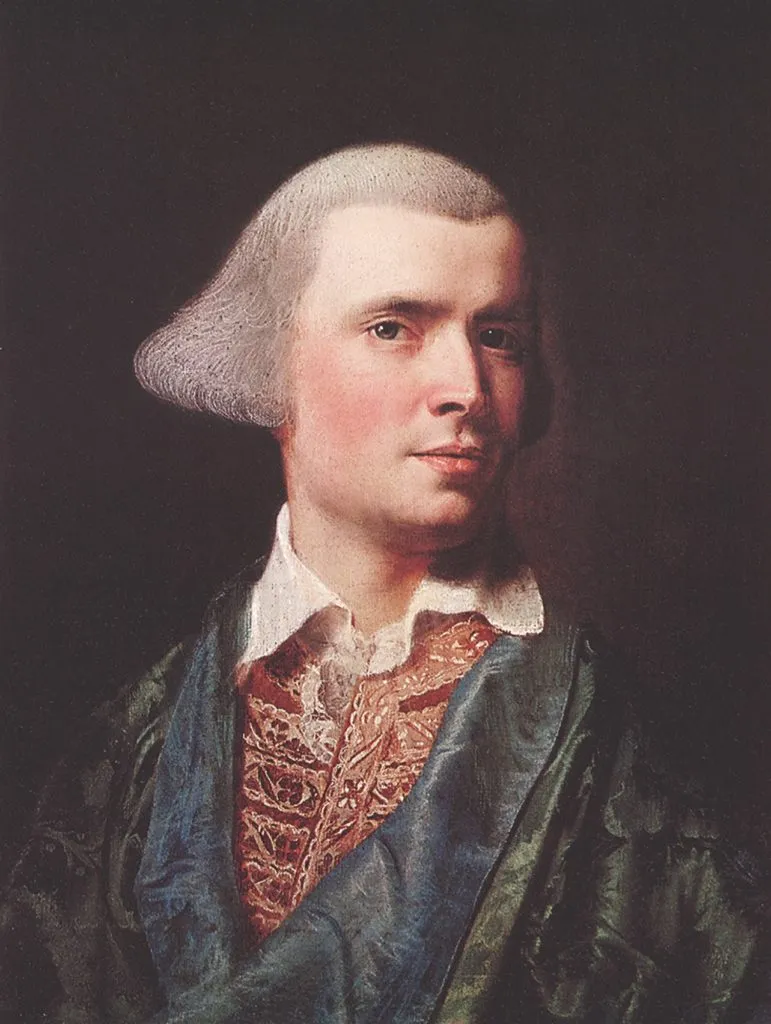
Trumbull writes that he did not understand his father’s reasoning concerning the expense of a college education and his father’s firm resolution that Trumbull should go. The Trumbull family had experienced a financial setback due to Jonathon Trumbull’s mercantile failure. Trumbull’s mother and sisters were depressed and even he, as a child, was melancholy. Trumbull records, “The tranquility of the arts seemed better suited to me than the more bustling scenes of life, and I ventured to remonstrate with my father, stating to him that the expense of a college education would be inconvenient to him, and after it was finished I should still have to study some profession by which to procur a living; whereas if he would place me under the instruction of Mr. Copley, the expense would probably not exceed that of a profession, and the means of supporting myself- perhaps of assisting the family, at least my sisters.” Trumbull was of course meaning the well-known painter John Singleton Copley, pictured below in a self-portrait from 1769. Trumbull writes that his father did not have the same appreciation for the fine arts that he, himself, possessed and so this argument would amount to nothing, as well.
Sizer, Theodore. “John Trumbull,” Patriot-Painter,” in Northern New York.” New York History 31.3 (1950)
Brookhiser, Richard. Glorious Lessons: John Trumbull, Painter of the American Revolution.